Selling Options for Income: Top 5 Strategies
In this article, we break down five strategies traders use to profit from time decay by selling options for income.
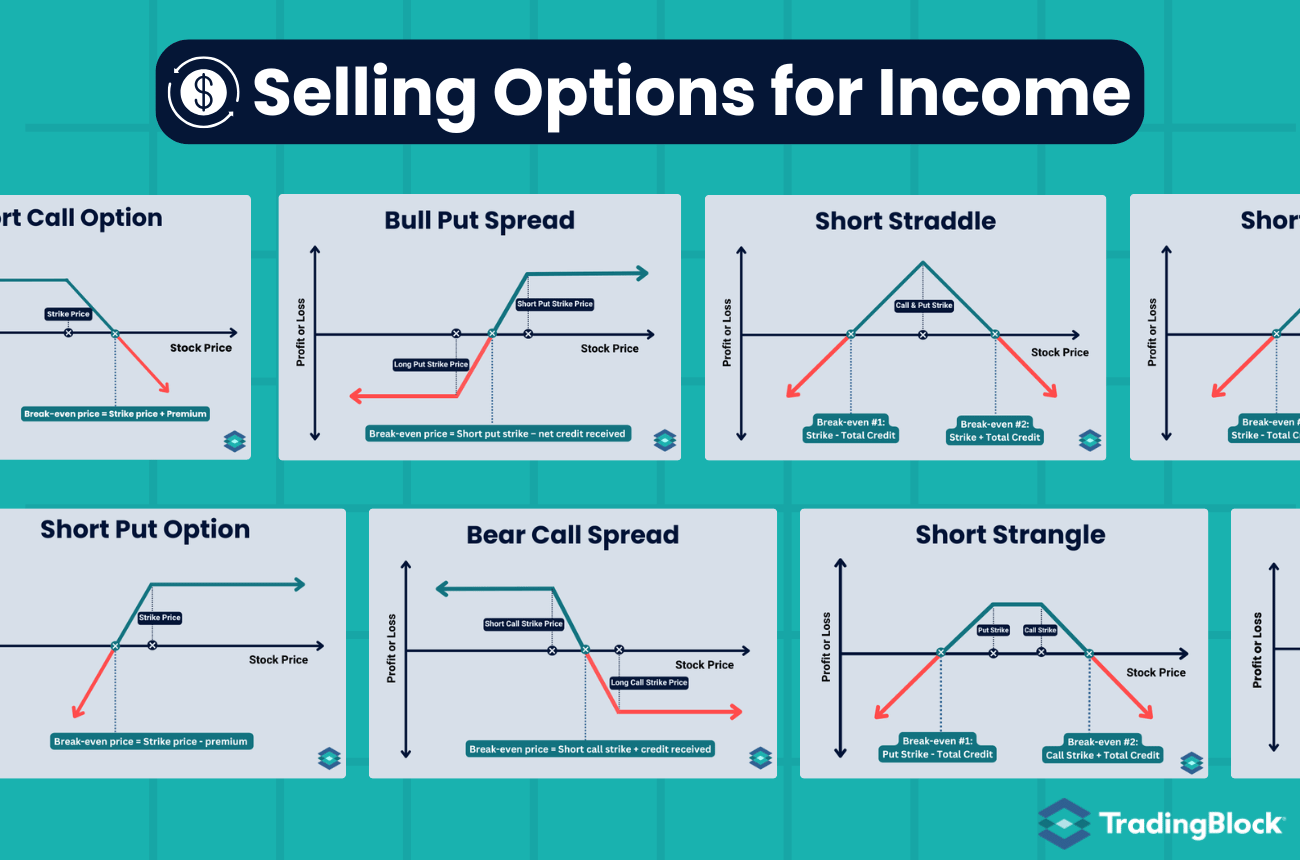
Options are incredibly versatile investment vehicles. You can combine them in almost infinite ways to express a view on nearly any market direction over any timeframe. The same is true with selling options, which remains a favorite strategy among professional traders.
Highlights
- Naked Calls & Puts: Take in a lot of premium but carry the most risk. You’re betting on time decay and IV falling while avoiding assignment and directional moves.
- Credit spreads: Defined-risk trades that limit upside. while mitigating risk.
- Covered calls and puts: Collect income from long or short stock positions.
- Cash secured puts: A cleaner, safer way to sell puts with cash ready if you get assigned.
- Straddles and strangles: Sell both sides, collect more premium, and hope the stock stays in a range.
Selling Options vs Selling Stocks
Selling options works very differently from selling stocks, even though both let you “sell to open.”
- Selling a stock to open is short selling and requires borrowing shares, which usually comes with a borrowing fee.
- Selling an option to open means you are taking the other side of a contract and agreeing to the obligation that comes with it.
You collect a credit upfront and want that option to lose value over time so you can keep as much of the premium as possible.
When you sell a put option, you’re taking a neutral to bullish view, while selling a call is a neutral to bearish trade. Both collect premium up front and rely on time decay to profit.
Buying vs Selling Options
Before we look at our top short option strategies, it helps to compare the basic mechanics of buying and selling options.
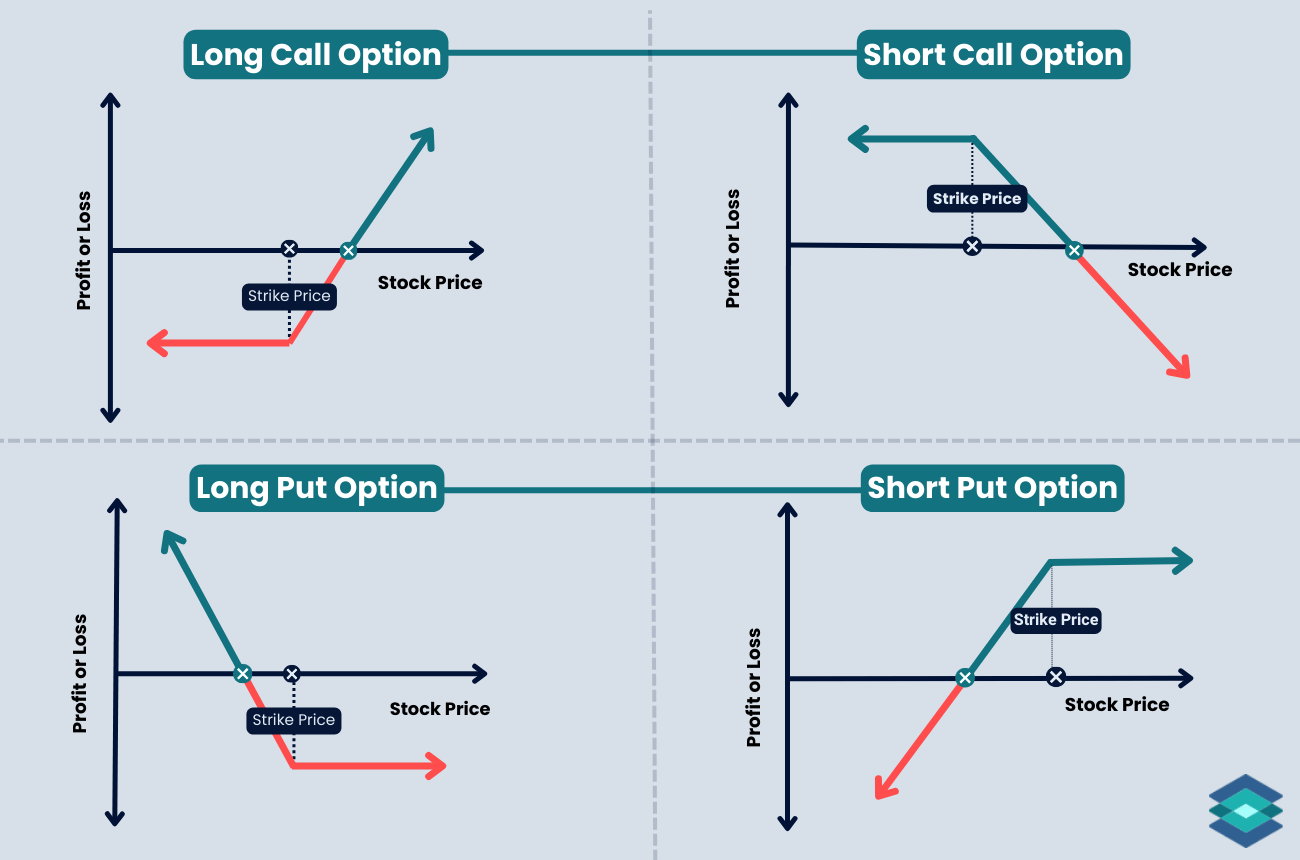
- Buying an option is a straightforward debit trade where your risk is limited to the premium you pay.
- Selling an option is a credit trade where you take on an obligation, collect premium upfront, and rely on time decay to work in your favor.
And remember: the long side always has the right to exercise their option. Call buyers can turn their option into 100 shares long, and put buyers can convert into 100 shares short. As the seller, you’re the one who must fulfill that assignment if it happens. More on assignment later!
Buying a Call Example
We will start with a long call example (buying a call) on ABC:
- ABC stock price: $100
- Call option strike price: $105
- Call option price: $2
- Trade cost to buy: $200
- Days to expiration (DTE): 30
Let’s say we went ahead and bought this call option for $2, or $200 total, because options typically represent 100 shares. We will fast-forward 30 days to option expiration to see how our trade plays out:
Updated values at expiration:
- ABC stock price: $100 → $103 📈
- Strike price: $105
- Call option price: $2 → $0 📉
- DTE: 30 → 0
In this example, even though the stock moved higher, the option expired worthless because ABC finished below our strike price of $105. The option didn't close in the money, so the entire $200 premium was lost.
Selling a Call Example
If we sold this option instead of buying it, we would initially receive a credit to our account equal to the premium. As long as the stock closes under the strike price at expiration, we would keep that credit.
Let’s jump back to our ABC example, but this time sell the 105 call. Here’s how the trade played out:
- ABC stock price: $100 → $103 📈
- Strike price: $105
- Call option price: $2 → $0 📉
- Premium collected: $2, or $200
- Margin requirement to sell: $700
- DTE: 30 → 0
- Option Value at Expiration: $0
- Profit: $2, or $200
Since ABC finished below the strike price of 105, the short call expires worthless, and we keep the premium.
This is the basic appeal of short options: you can profit even when the underlying moves against you, as long as it stays on the “safe” side of your strike at expiration.
But keep in mind the cost to sell options naked is much higher than buying them. That is because the risk is so much greater. For short calls (AKA naked calls), there is no ceiling on how high the underlying stock can go, so your broker will require you to set aside margin for the trade. In this example, that margin was $700.
Short Options and Assignment Risk
One of the most significant risks to short option positions is assignment risk. Here is how the assignment process works:
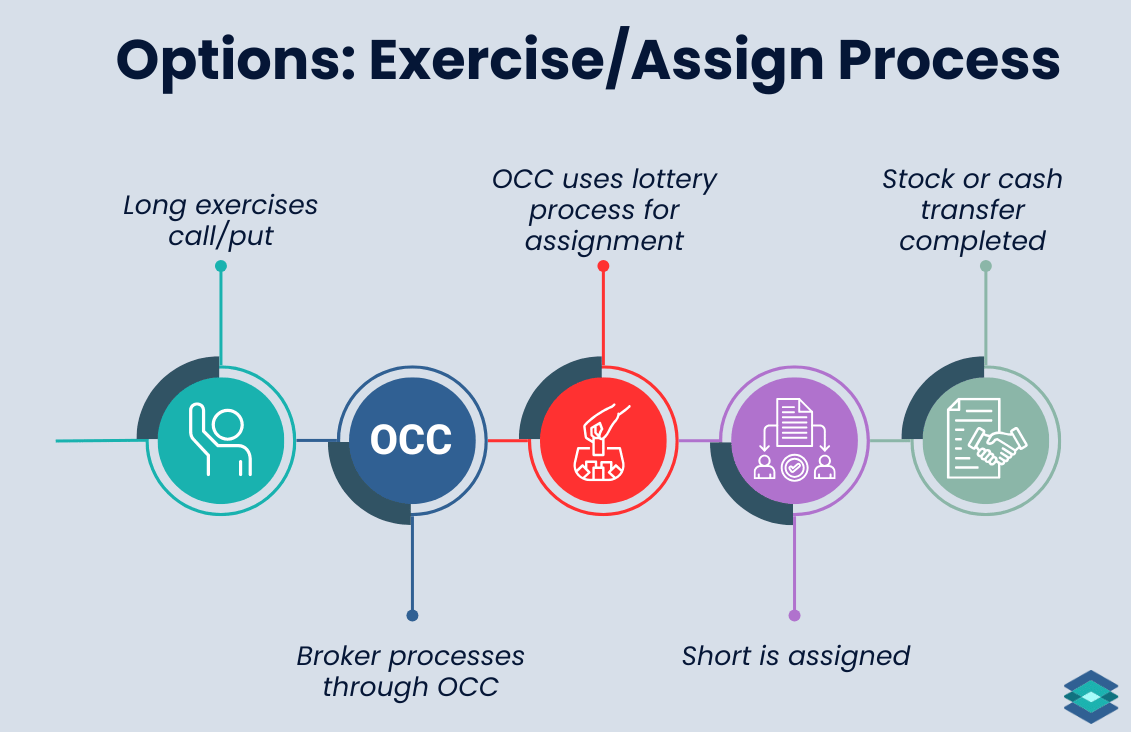
The owners of both long puts and calls have the right, but not the obligation, to convert their option to long stock (calls) or short stock (puts).
- Long call: can become 100 shares long
- Long put: can become 100 shares short
For example, let’s say with 10 DTE, the price of ABC in our previous example was at $107/share. The $105 call now has $2 of intrinsic value. Since the option already behaves like stock and has little time value left, the call buyer may choose to exercise their right to convert their call to 100 shares of ABC at the strike price.
If you are short that call:
- You must deliver 100 shares at $105
- Market price is $107, so you have a $2 loss per share
In the money American-style options are always at risk of being assigned, and that risk increases as expiration approaches. This is because the long side sees little benefit in holding the derivative at that point. Most of the potential return is already locked in through intrinsic value, so the natural question becomes: why not just own the stock?
Let’s now differentiate between American and European-style options, which is prerequisite material for all option sellers.
American vs European Style Options

Being able to differentiate between American and European-style options is crucial before selling options:
American Style Options
American-style options can be exercised at any time and require delivery of the underlying shares upon exercise/assignment. Because of this, early assignment is always possible.
Most equity and ETF options in the U.S. follow this style.
European Style Options
European-style options can be exercised only at expiration and are cash settled. Instead of delivering shares, the account is simply adjusted by the intrinsic value.
Example:
If SPX is trading at 7,000 on expiration and you are long the 6,995 call, the option closes 5 points in the money. With SPX at $100 per point, that results in:
- 5 points × $100 = $500 cash settlement
No shares are delivered because the contract is cash-settled. The long party simply receives the intrinsic value, and the short party pays it.
Common European-style underlyings include major indices:
- SPX
- NDX
- RUT
- VIX
When Should I Sell Options?
You should consider selling options when implied volatility is elevated but expected to come down. Higher IV means higher option premiums, and when you are selling options, you want to collect as much premium as possible.
Time decay is another major advantage for option sellers, because every day that passes reduces the option’s extrinsic value. If the underlying stays within your expected range, theta works in your favor and can steadily erode the option’s price, even if the stock barely moves.
Generally speaking, you don’t want to sell options that expire more than 45 days away. This is because you’ll be waiting a long time for time decay to kick in. I tend to sell options with 30 to 3 DTE, depending on my strategy.
.png)
5 Option Selling Strategies
Without further ado, let’s now explore five popular options-writing strategies. Keep in mind that there are some huge differences in the risk profiles of these trades.
1. Selling Options Naked
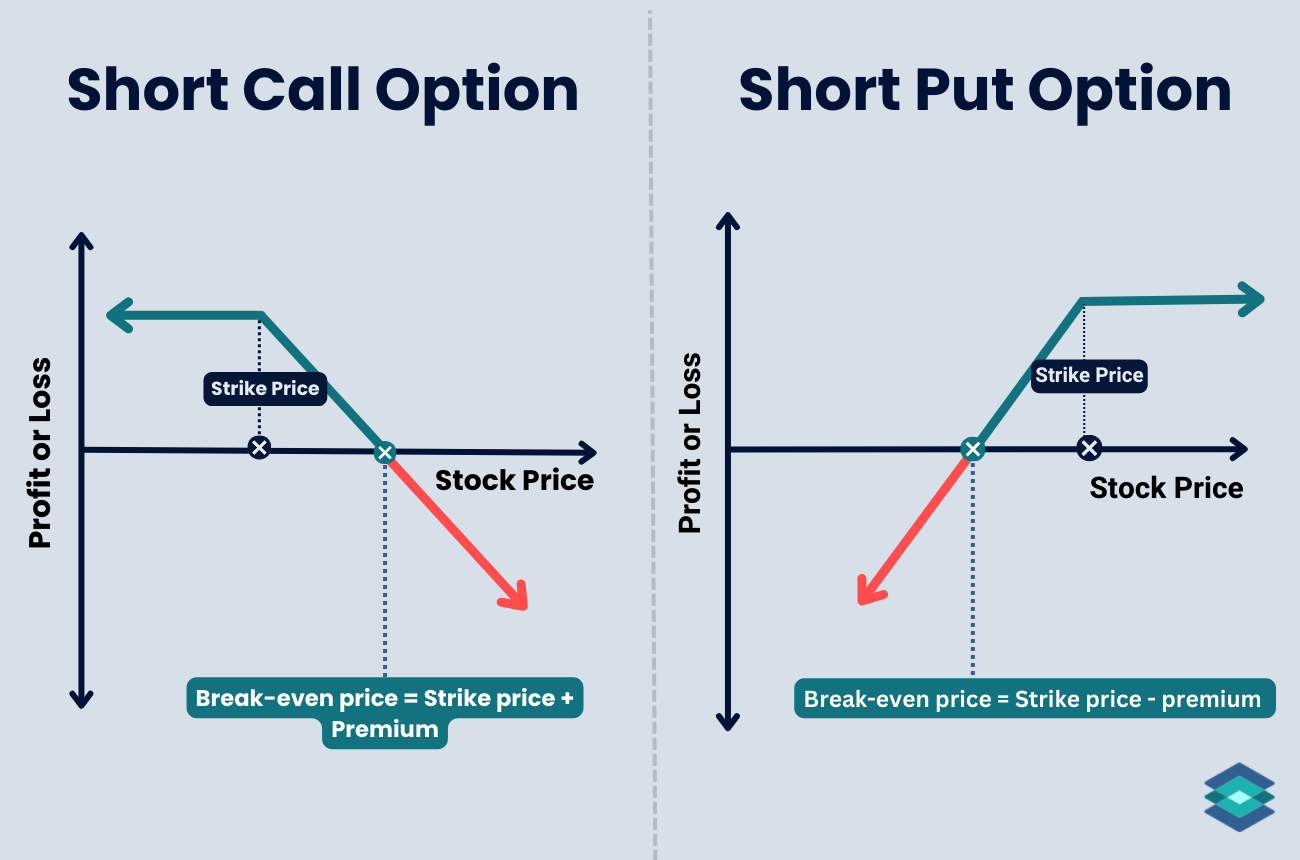
Selling options naked is one of the riskiest yet potentially most profitable strategies on our list. “Naked” simply means you don’t have any other position in the underlying, such as stock or other options, to help hedge losses.
If you sell a call option naked, your risk is unlimited because there is no ceiling on how high the underlying stock can go. Naked puts also carry significant risk, since a stock can, in theory, go to zero.
You collect credit up front by selling either a call option or put option, and rely on time decay and implied volatility to work in your favor. Let’s jump to an example:
Short Put Example
We opened this article with an example of a naked short call. Let’s take a look at a short naked put on Invesco QQQ Trust (QQQ):
Example:
- QQQ price: 475.01
- Short put strike: 450
- Option price (premium collected): 6.73
- Max profit: $673
- Breakeven: 443.27
- Days to expiration (DTE): 44
If QQQ stays above 450 through expiration, the option expires worthless and you keep the full credit. Time decay helps every day the ETF holds above your strike.
Now let’s see what happens if QQQ drops about 7% by expiration:
Updated values at expiration:
- QQQ price: 475.01 → 442 📉
- Short put strike: 450
- Premium collected: 6.73
- Option price at expiration: 8.00 📈 (intrinsic value only: 450 − 442 = 8)
- Breakeven: 443.27
- DTE: 44 → 0
Since QQQ finishes at 442, the 450 put is 8 points in the money. Your loss is based strictly on intrinsic value minus the premium you collected:
Loss = 8.00 − 6.73 = 1.27 → $127 loss
However, since we let this in the money put go to expiration, it will be assigned. That means you will be required to buy 100 shares at the 450 strike, and those shares will appear in your account before the next trading day. This can expose you to further losses if QQQ continues to fall after assignment.
2. Credit Spreads (Defined Risk)
Credit spreads involve selling one option and buying another option of the same type (both calls or both puts), with both options sharing the same expiration date but using different strike prices.
The short strike brings in premium, and the long strike caps your risk. This creates a defined-risk, defined-reward trade that still benefits from time decay but carries far less risk than selling options naked, as we just covered.
There are two primary types of credit spreads: the bear call spread and the bull put spread.
Bear Call Spread
The bear call spread is a defined-risk, bearish-to-neutral trade that profits when the stock stays below a certain level. This vertical spread offers a safer alternative to selling a naked call, but it also limits potential gains.
Here’s a visual of this strategy at expiration:

To build a bear call spread, do the following:
- Sell 1 call option (closer to the money)
- Buy 1 call option (further out of the money)
- Both options have the same expiration
The call you sell has a lower strike (and therefore higher premium) than the call you buy, which results in a net credit. As long as the stock stays below your short call leg, you will realize your full profit potential of the credit collected.
Bear Call Spread Example
In this example, we’re setting up a bear call spread on XLF (Financial Select Sector SPDR Fund). Here are the options we will choose:

Trade Details
- XLF Price: 45.72
- Expiration: 39 days
- Sell 48 Call @ $0.73
- Buy 51 Call @ $0.14
- Net Credit Received: $0.59 ($59 total)
- Breakeven Price: $48 + $0.59 = $48.59
- Max Profit: $0.59 ($59 total)
- Max Loss: $3.00 – $0.59 = $2.41 ($241 total)
We’re selling the 48/51 call spread on XLF and taking in a net credit of $0.59. Our max profit is $59, which we earn if XLF stays below $48 at expiration.
Our max loss happens if XLF finishes above $51. In that case, we lose the full width of the spread ($3.00) minus the credit received, for a total loss of $2.41, or $241.
Bull Put Spread
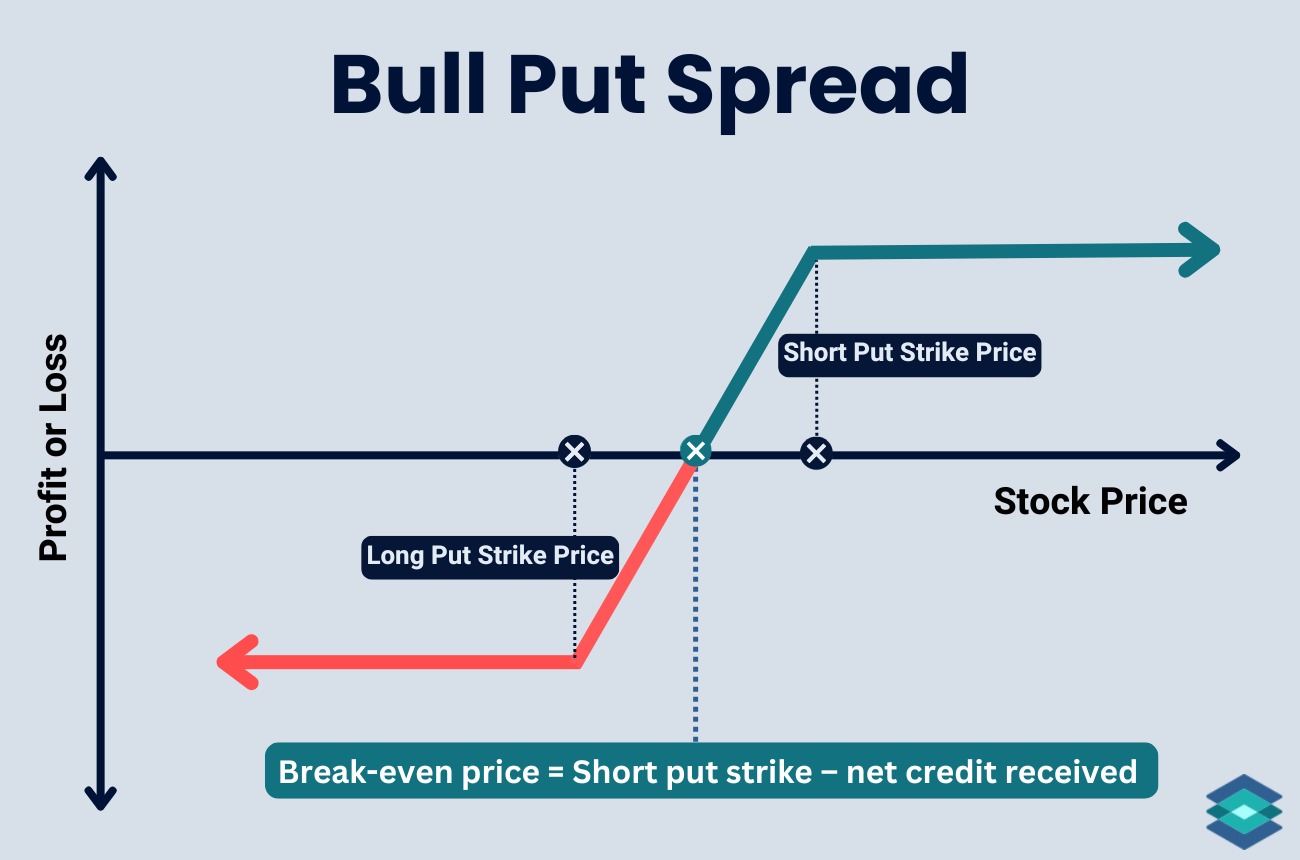
The bull put spread is a defined-risk, bullish-to-neutral trade that profits when the stock stays above a certain level. This vertical spread is a safer alternative to selling a naked put, but it also limits your potential gains.
Here’s a visual of this strategy at expiration:
And here’s how you build a bull put spread:
- Sell 1 put option (closer to the money)
- Buy 1 put option (further out of the money)
- Both puts share the same expiration date
Because the short put has a higher strike price, it carries more premium than the long put. This results in a net credit, which is your maximum profit.
As long as the stock stays above your short put strike, you will realize that full credit at expiration.
Bull Put Spread Example
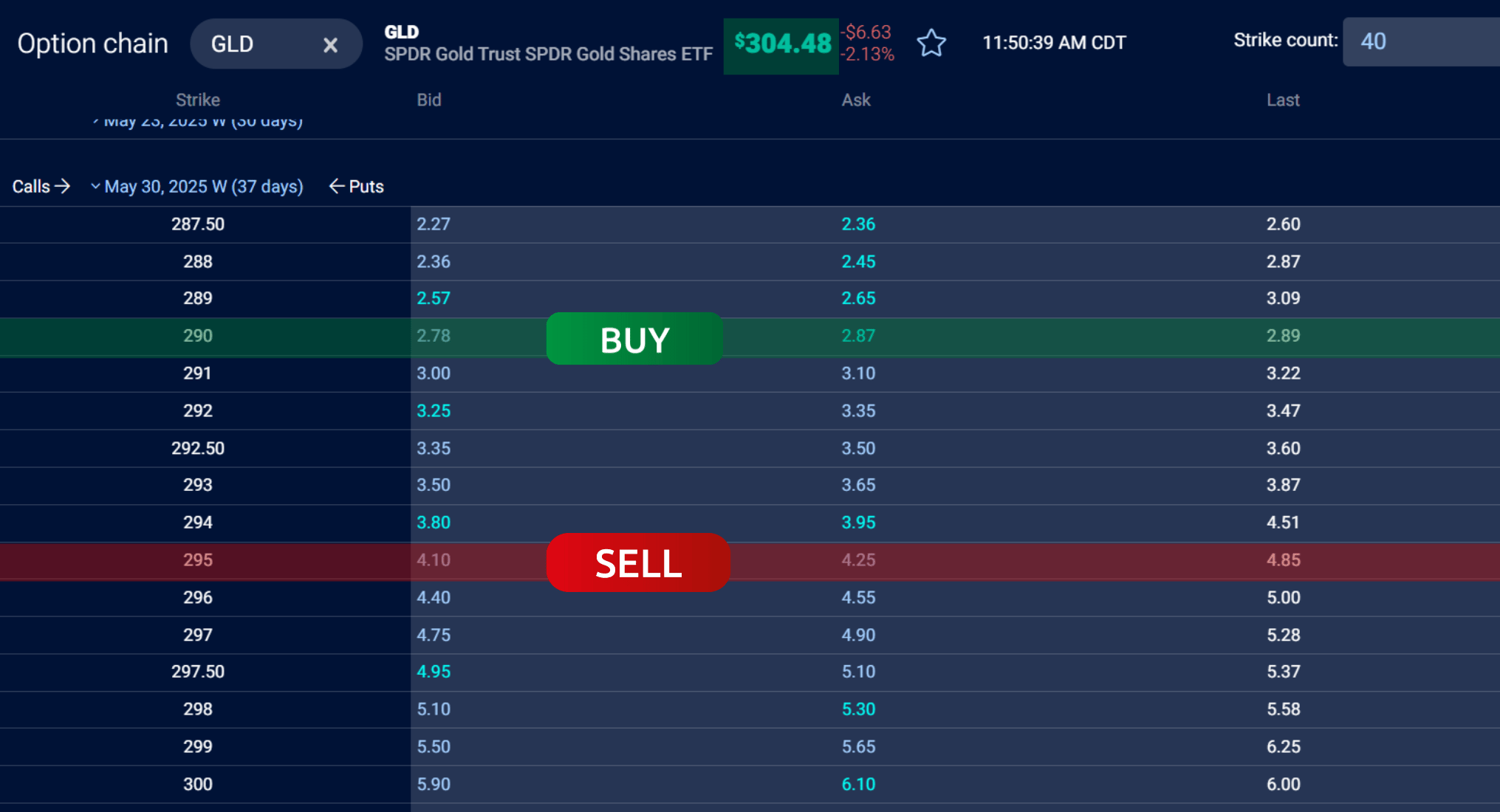
In this example, we’re setting up a bull put spread on GLD (SPDR Gold Trust SPDR Gold Shares). Let’s choose our options on the options chain:
Trade Details
- GLD Price: 304.48
- Expiration: 37 days
- Sell 295 Put @ $4.17
- Buy 290 Put @ $2.82
- Net Credit Received: $1.35 ($135 total)
- Breakeven Price: $295 − $1.35 = $293.65
- Max Profit: $1.35 ($135 total)
- Max Loss: $5.00 − $1.35 = $3.65 ($365 total)
So, we sold the 295/290 5-point put spread on GLD for a net credit of $1.35. This means the most we can make is $135, which happens if GLD is trading at $295 or higher on the expiration date. Our max loss here is $365, and occurs if GLD falls to $290 or lower by expiration.
3. Covered Calls & Covered Puts
Covered puts and covered calls differ from the other strategies listed here because they require 100 shares of the underlying per option sold. These strategies give long or short stock positions a way to generate income when a trader is neutral or only mildly bullish or bearish
Covered Calls
Covered calls are market-neutral to mildly bullish trades that generate income when the stock stays flat or rises modestly. Traders use them to collect premium while holding stock.
The covered call consists of two components:
- Purchasing 100 shares of stock
- Selling 1 call option
And here is the payout profile:
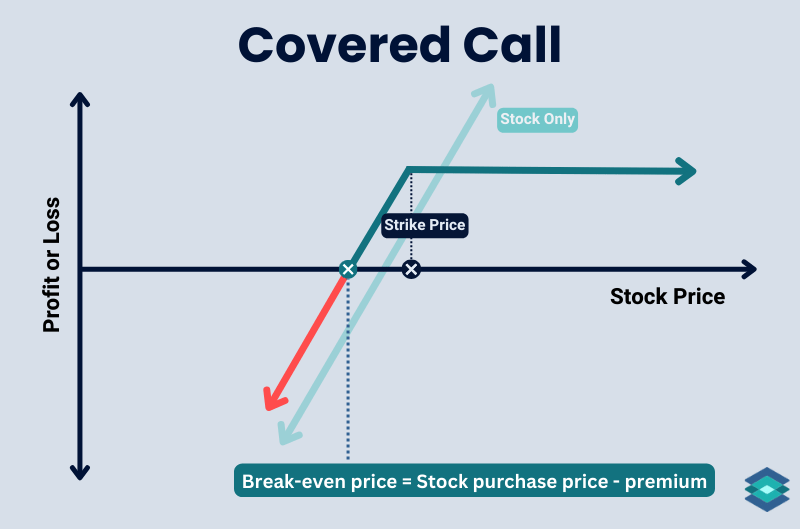
- Max profit: Premium collected plus any gains up to the strike
- Max loss: Same as owning stock, reduced by the premium
- Breakeven: Stock price minus the premium
You can enter a covered call in one trade or sell calls against an existing long stock position.
Here is a payoff diagram of a covered call at expiration. Note how its breakeven is lower by the amount of the premium collected when compared to simply owning the stock.
Covered Puts
Covered puts work the same way covered calls do, but in reverse. Instead of holding long stock and selling calls, you hold short stock and sell puts against it.
The short put brings in income while you wait for the stock to drift lower or stay flat. It also slightly improves your breakeven, but it caps downside profits once the stock falls to the put strike.
The covered put consists of two parts:
- Short 100 shares of stock
- Sell 1 put option against it
And here is the payout formula:
- Max profit: Premium collected plus any gains as the stock falls to the strike
- Max loss: Same as being short stock, increased by how far the stock can rise (offset only by the premium)
- Breakeven: Stock sale price plus the premium collected
Here is the payoff diagram of a covered put at expiration:

4. Cash Secured Puts
Cash-secured puts work a lot like selling a naked put, but with one important difference: the trade is fully backed by cash. Instead of using margin to sell the put, you set aside enough buying power to purchase 100 shares if you are assigned.
This makes the position far less risky than a naked put and is a common way for traders to generate income while waiting to buy a stock at a lower price. It is also allowed in many IRA accounts.
The cash secured put consists of two components:
- Sell 1 put option (typically out of the money)
- Set aside enough cash to buy 100 shares at the strike
This strategy works best when you are neutral to mildly bullish. If the stock stays above your strike at expiration, the put expires worthless and you keep the premium. If the stock falls below the strike, the put is assigned and you buy shares at your chosen price.
Here is the payoff diagram of a cash-secured put at expiration

5. Short Straddles and Strangles
Short straddles and strangles take maximum advantage of time decay by selling both a call and a put at the same time. This collects roughly twice the premium of selling a single option, but also increases risk, especially in American-style options where assignment risk can be very high.
The difference between a straddle and a strangle comes down to the strikes you sell.
- Straddles involve selling the call and put at the money.
- Strangles involve selling an out of the money call and an out of the money put.
The former collects more premiums, while the latter has a higher probability of success.
Short Straddle

The short straddle is comprised of:
- Sell 1 at the money call option
- Sell 1 at the money put option
- Both options have the same expiration cycle.
Short straddles are a favorite setup before earnings because implied volatility usually spikes into the event. When the announcement passes, IV often collapses, and that volatility crush can quickly reduce the value of both options.
For example, let’s say ABC, a highly volatile stock, is trading at $100 a few days before earnings. Here’s our trade:
- ABC Price: $100
- DTE: 3 days
- Sell 100 Call: $4.50
- Sell 100 Put: $4.30
- Total Credit Collected: $8.80 ($880 total)
- Breakeven Prices:
- Upside: 100 + 8.80 = 108.80
- Downside: 100 − 8.80 = 91.20
- Max Profit: $8.80 ($880 total)
- Max Loss: Unlimited
Let’s say earnings came out and ABC rallied 4%, moving from $100 to $104. It is now expiration day (0 DTE), so only intrinsic value remains.
Updated values at expiration:
ABC stock price: $100 → $104 📈
Call option price: $4.50 → $4.00 (intrinsic value only)
Put option price: $4.30 → $0.00 📉
Total option value: $8.80 → $4.00
DTE: 3 → 0
Profit: $8.80 credit − $4.00 = $4.80 profit ($480 total)
The straddle still finishes profitable because ABC stayed within the breakeven range and implied volatility collapsed into expiration.
Short Strangle
.png)
The short strangle is a wider version of the straddle. Instead of selling both options at the money, you sell out of the money options on both sides, giving the trade more breathing room but collecting less premium.
The short strangle is comprised of:
- Sell 1 out of the money call option
- Sell 1 out of the money put option
- Same expiration date
Short strangles work when the stock stays between your strikes and implied volatility falls. I prefer the short strangle over the short straddle because of the cushion it provides.
Risks of Selling Options
The risks of selling options depend entirely on the strategy you are using. With that in mind, here are a few core risks you should know:
- Unlimited or large losses: Short calls can have unlimited upside risk and short puts can lead to significant losses during sharp selloffs.
- Liquidity: Trade options with strong liquidity such as high open interest, solid volume, and tight bid and ask spreads. Read more about options liquidity here.
- Assignment: Monitor in the money positions carefully because they carry assignment risk.
Comparing Strategies
Let's conclude by comparing the five different strategies we just covered:
Options involve risk and are not suitable for all investors. Examples in this article are for education only and are not recommendations to buy or sell any security or strategy. Losses can exceed expectations, especially with uncovered positions. Trade examples do not include commissions, fees, or other transaction costs. Review the Characteristics and Risks of Standardized Options before trading. Past performance is not indicative of future results.
FAQ
Options sellers make money from time decay. As time passes, the extrinsic value of most options usually declines unless the stock makes a large move or implied volatility rises. If the option expires worthless, you keep the full credit.
Yes. Premium collected is treated as short term capital gain when the position closes or expires.
Short options are taxed when the position is closed, assigned, or expires. The result is usually short-term capital gain or loss (unless the options is a LEAPS). There are exceptions for index options, such as SPX, which have favorable tax treatment.
For example, let’s say ABC is trading at 100. The 105 call is trading at 1.00. If you sell the 105 call and ABC stays below 105 through expiration, you keep the full 1.00 or $100 collected.
If you know what you are doing and you understand risk, selling options can absolutely be worth it. In fact, most professional traders prefer selling premium because theta works in your favor and the probability of profit is often higher than buying options.

.png)


.png)
.png)