

A free TradingBlock course

Master options trading.
All on one page.

Twenty-six strategies. Fifty-six lessons. Ten calculators.
Written by an options broker with fifteen years on the desk.
Free, with no signup.

05 Modules
56 Lessons
26 Strategies
10 Calculators
Read this first

Options 101

A short primer on what options are, how they differ from stocks, and how they're priced. Read this first if options are new to you.

What is an option?

An option is a financial contract that gives the holder the right (but not the obligation) to buy or sell an underlying asset at a specified strike price by a specified expiration date. The underlying is typically a stock, ETF, index, or futures contract. There are only two types of options contracts: calls and puts. Every options strategy ever devised is built from these two, alone or in combination.

Stocks vs options

Stocks confer ownership: voting rights, dividends, a residual claim on the company. Options do not; the holder owns only the contract. Stocks also don't expire, but every option does. As expiration approaches, an option's time value decays, a process measured by the Greek theta.

Plain-English analogies

A put option works like auto insurance. You pay a premium each month to insure your car. If something damages it, the insurer absorbs the loss above your deductible. If nothing happens, the premium is forfeited.

A put works the same way. You pay a premium for the right to sell the underlying at the strike price. If the asset drops below that strike, the put covers your downside. If it doesn't, the put expires worthless. The Chicago Board Options Exchange was founded in 1973 to bring this kind of standardized protection to the equity markets.

A call option works like a down payment on a house. You put down earnest money to lock in a purchase price during a closing window. If the home's market value rises before you close, you've locked in the lower price and the upside is yours. If you walk away, you forfeit the deposit but owe nothing else.

A call works the same way. You pay a premium for the right to buy the underlying at the strike price. If the asset rallies above the strike, the call captures the upside. If it doesn't, the call expires worthless and your maximum loss is the premium paid.

Long call vs long put profit and loss diagrams

How pricing works

An option's premium has two components: intrinsic value (how far the option is in-the-money) and extrinsic value (time remaining to expiration, implied volatility, interest rates, and dividends). Extrinsic value decays to zero by expiration.

An example showing intrinsic value for a call option

How an option's price responds to market changes is governed by the Greeks: Delta, Gamma, Theta, Vega, and Rho.

Implied volatility

Implied volatility (IV) is the most influential driver of an option's price. It's the market's forecast of future price movement, expressed as an annualized percentage: high IV means expensive options, low IV means cheap ones. IV doesn't care about direction, only magnitude. It tends to spike before known events (earnings, FDA decisions, Fed meetings) and collapse afterward, a phenomenon known as IV crush. The IV Rank vs IV Percentile article shows how to read IV in context.

Four building blocks

Every options trade is built from four atomic transactions:

TransactionOutlookRisk profile
Long callBullishDefined risk, unlimited reward
Long putBearishDefined risk, capped reward
Short callBearish/neutralCapped reward, unlimited risk
Short putBullish/neutralCapped reward, capped risk

Combinations of these four produce named strategies: vertical spreads, iron condors, straddles, calendar spreads, and many more. Module 3 covers them all.

That's the foundation. Let's begin.

Module One
01

Options fundamentals

The vocabulary and mechanics every options trader needs before placing a single trade. Strikes, premiums, moneyness, expirations, and how the contract actually settles when the bell rings.

8 lessons · ~45 min
1.1 What Is a Strike Price? The exercise price baked into every options contract. 6 min
Option Strike Price

In options trading, the strike price is the price at which the owner of a call or put option can exercise their contract and convert it into the underlying asset. The term comes from Old English. When two parties would "strike" a deal, and before options were standardized, contracts were just two trusting people agreeing on terms.

Holders of long call options have the right to buy the underlying at the strike price anytime before expiration. Holders of long put options have the right to sell at the strike price. The strike is fixed; the stock price moves. The relationship between the two is what determines whether your option finishes in or out of the money.

Highlights
  • Strike Price: The agreed-upon price to buy (calls) or sell (puts) the underlying asset.
  • Fixed Strike: The strike doesn't change. The stock price moves around it, defining ITM/ATM/OTM.
  • Profit Calculation: Strike prices are crucial to determining profit, loss, and breakeven.
  • Moneyness: The relationship between strike and underlying defines an option's moneyness and assignment odds.
i
Pro Tip American-style options (ETFs like SPY and QQQ, plus individual equities) can be exercised any time before expiration. European-style options (cash-settled index options like SPX and NDX) can only be exercised at expiration. The distinction matters for assignment risk and dividend strategies.
Begin the Strike Price lesson
1.2 Option Premiums Explained The price of an options contract. Debit for buyers, credit for sellers. 7 min
Option Premium

The premium is the price of an options contract. When you buy an option (go long), the premium paid is called the debit. When you sell an option (go short), the premium received is called the credit. Premiums fluctuate constantly with the underlying, but price isn't the only driver. Days until expiration and implied volatility move the premium just as much.

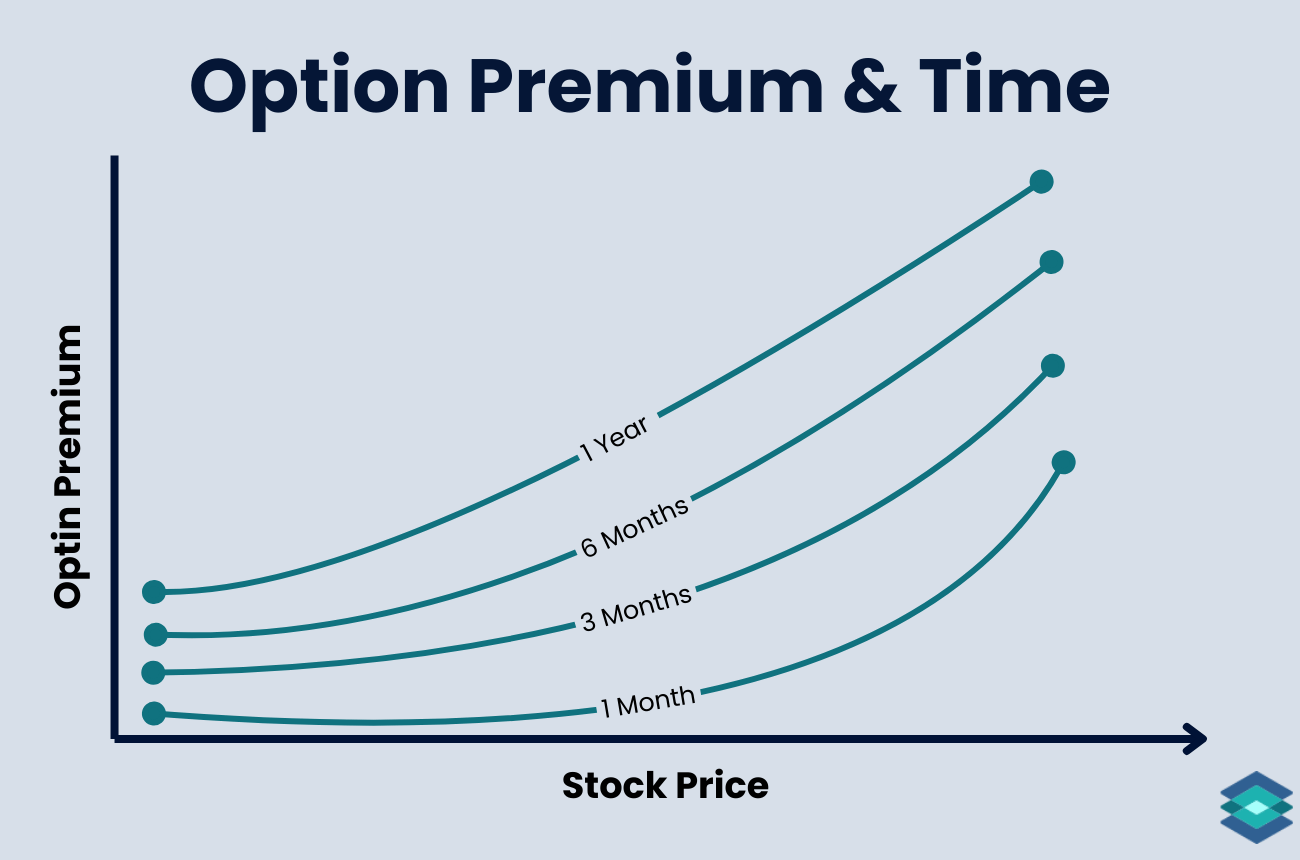
Every option premium breaks into two components: intrinsic value (the amount the option is in-the-money) and extrinsic value (everything else: time, volatility, dividends, interest rates). At expiration, all extrinsic value goes to zero. What's left is intrinsic value, or nothing at all.

Highlights
  • Premium = Intrinsic Value + Extrinsic Value
  • Buyers pay the premium (debit). Sellers receive it (credit).
  • Intrinsic value reflects how far ITM the option is, based on strike vs. underlying.
  • Extrinsic value is time + volatility, and decays as expiration approaches.
i
Pro Tip Option sellers aim to collect maximum premium. Many avoid selling options just days before expiration, when extrinsic value is low. The sweet spot for selling is around 45 days to expiration. Then roll to the next month to collect more premium.
Begin the Option Premium lesson
1.3 Intrinsic vs Extrinsic Value The two components that make up every option premium. 5 min
Intrinsic vs Extrinsic Value

Intrinsic value is an option's value on its own, independent of external factors like time and volatility. It's simply how far in-the-money the option currently is. A 100-strike call when the stock is at $105? That has $5 of intrinsic value. The 110 call? Zero intrinsic value, because it's out-of-the-money.

Extrinsic value is everything else. The portion of premium influenced by time, implied volatility, dividends, and interest rates. Out-of-the-money options have only extrinsic value. As expiration approaches, that extrinsic value bleeds away (theta decay), and what's left at expiration is purely intrinsic.

Highlights
  • Intrinsic value = how far ITM the option is. Can never be negative.
  • Extrinsic value = time premium + volatility + dividends + interest.
  • OTM options have only extrinsic value. There's no intrinsic component.
  • At expiration, extrinsic value collapses to zero. Only intrinsic value survives.
Begin the Intrinsic & Extrinsic lesson
1.4 Option Moneyness: ITM vs ATM vs OTM Where your strike sits relative to the underlying, and why it drives everything. 5 min
Option Moneyness

Moneyness refers to the relationship between an options contract's strike price and the underlying asset's current price. Every option falls into one of three states: in-the-money (ITM), at-the-money (ATM), or out-of-the-money (OTM). This single concept drives delta, premium, and the probability of finishing in profit.

For a call, ITM means the stock is above the strike. For a put, ITM means the stock is below the strike. ATM is where they cross. OTM is where the option has zero intrinsic value. Only time premium. Most retail traders gravitate to OTM options because they're cheap; most of those options expire worthless.

Highlights
  • ITM Call: Stock price > Strike. ITM Put: Stock price < Strike.
  • ATM: Stock price = Strike. Highest gamma, highest theta.
  • OTM: Has only extrinsic value. Must move ITM to be worth anything at expiration.
  • If you're short an option that goes ITM, your odds of being assigned shoot up. Pay attention.
Begin the Moneyness lesson
1.5 Options Expiration: Cycles, Risks, and 0DTE Monthly, weekly, 0DTE. Plus pin risk and auto-exercise. 8 min
Options Expiration

Options expire on a specific date set in the contract. Three main cycles exist: monthly (third Friday of each month), weekly (every Friday), and 0DTE (zero days to expiration. Same-day expirations on SPY, SPX, QQQ, and a growing list of names). Each cycle has different liquidity and risk dynamics.

As expiration approaches, time decay accelerates and gamma climbs. The last few days before expiration are when most theta gets paid out, and where the biggest gamma surprises happen. Understanding pin risk (when the underlying closes near a short strike) and auto-exercise (when brokers automatically exercise long ITM options) is essential before you ever hold a position into the close.

Highlights
  • Three main cycles: monthly, weekly, and 0DTE.
  • Time decay (theta) accelerates exponentially in the final weeks.
  • Pin risk: when the underlying closes near a short strike. Assignment becomes a coin flip.
  • Auto-exercise: brokers automatically exercise long ITM options at expiration.
Begin the Expiration lesson
1.6 Options Liquidity: Volume, Open Interest, Spreads The four metrics that decide whether you'll get filled at a fair price. 6 min
Options liquidity: bid-ask spread illustration

Liquidity refers to how easily an option can be bought or sold without causing a material impact on its price. Trade illiquid options and you'll pay the spread on entry and exit. A tax that compounds across every round trip. Four metrics tell you what you need to know: volume, open interest, bid/ask spread, and bid/ask size.

The most liquid names. SPY, SPX, QQQ, IWM, and the largest sector ETFs trade with penny-wide spreads even on far-dated strikes. The further you stray from those, the wider the spread gets and the harder a fair fill becomes. For new traders, sticking to highly liquid underlyings is the single fastest way to stop bleeding edge.

Highlights
  • Volume: contracts traded today. Indicates current activity.
  • Open Interest: total open contracts. Indicates depth of the market.
  • Bid/Ask Spread: the difference between buy and sell prices. Tighter is better.
  • Bid/Ask Size: how many contracts are available at each level.
Begin the Liquidity lesson
1.7 Exercise & Assignment What actually happens when an option is exercised, and what shows up in your account. 7 min
Option Exercise and Assignment

When a long put or call holder exercises their option, the corresponding short is assigned the underlying asset. Long calls exercise to buy 100 shares per contract at the strike; long puts exercise to sell 100 shares at the strike. The seller on the other side has no choice. They're getting assigned.

Most US equity and ETF options are American-style. They can be exercised at any time before expiration. This means if you're short, you can be assigned at any moment, especially around dividends or when an option goes deep ITM. Index options like SPX and NDX are European-style: exercise only happens at expiration. That's a big reason professionals prefer trading them.

Highlights
  • Exercise = the long holder converts the option into the underlying.
  • Assignment = the short side is forced to deliver the underlying.
  • American-style (most equities/ETFs): exercise any time before expiration.
  • European-style (most indexes): exercise only at expiration.
Begin the Exercise & Assignment lesson
1.8 How to Read an Options Chain The table where every options trade actually starts. 8 min
An options chain example

An options chain displays all listed calls and puts for a specified underlying asset. Chains are organized in an accordion style. Once an expiration period is selected, all calls and puts that expire within that period become viewable, with strikes running down the middle.

Each row shows the strike, plus the bid, ask, last price, volume, open interest, and Greeks for both the call and the put at that strike. Reading a chain fluently is non-negotiable. It's where every options trade starts. Once it clicks, you can spot mispriced contracts, weird IV setups, and unusual flow at a glance.

Highlights
  • Chains are organized by expiration cycle, with calls and puts for each strike.
  • Standard columns: bid, ask, last, volume, open interest, Greeks (delta, theta, IV).
  • The midpoint between bid and ask is usually a fair starting place for a limit order.
  • Wide spreads, low volume, or low OI are signs to slow down and reconsider.
Begin the Options Chain lesson
Module 1 · Knowledge check

Quiz: Fundamentals

Five questions. Instant feedback. Score 4 out of 5 to move on.

Score 0 / 5
Question 1 of 5
A long call option gives the holder the right to:
WhyCalls give the right to buy at the strike. Puts give the right to sell. The premium paid is the most a buyer can lose.
0%
0 out of 5 correct
Module Two
02

The option Greeks

The five risk metrics that turn options from a guessing game into a measured trade. Each Greek answers one question: how does my position change when something else moves?

5 lessons · ~30 min
2.1 Delta (∆): Price Sensitivity How much an option's price moves per $1 change in the underlying. 10 min
Delta

Delta is the most important of all option Greeks. It tells us how much the price of an option (call or put) will respond to a $1 change in the underlying asset's price. But delta does more than measure price sensitivity. It also tells us how many shares of stock an option trades like, the probability of an option expiring in-the-money, and the directional risk a position carries.

Calls have positive delta (bullish), puts have negative delta (bearish). A 0.50 delta call moves $0.50 for every $1 move in the underlying, and trades like 50 shares of stock. Whether you're adjusting exposure, managing risk, or picking a strategy, delta is a must-have in your trader toolbox.

Highlights
  • Price Sensitivity: Delta measures how much an option's price moves per $1 in the underlying.
  • Directional Risk: Calls have positive delta (bullish), puts have negative delta (bearish).
  • Hedging & Portfolio Management: Delta helps traders adjust positions to maintain desired exposure.
i
Pro Tip Market makers hedge delta constantly. Too many call buyers can force them to buy stock, sometimes triggering a gamma squeeze.
Begin the Delta lesson
2.2 Gamma (Γ): Delta's Acceleration How fast delta changes when the underlying moves. 8 min
Gamma

Gamma measures the acceleration of an option's price movement. Delta shows how much an option's price moves per $1 change in the underlying; gamma tells you how fast that delta itself changes. This makes at-the-money options highly sensitive as expiration nears. Think of delta as speed, and gamma as the horsepower behind it.

Long positions have positive gamma; short positions have negative gamma. High gamma means greater price sensitivity to underlying moves, especially in low-volatility markets where small movements can significantly impact delta.

Highlights
  • Delta's Acceleration: Gamma measures how much delta changes when the stock moves $1.
  • Volatility Impact: High gamma means greater price sensitivity, especially in quiet markets.
  • Gamma Hedging: Adjusting delta-neutral positions to manage gamma risk through continuous rebalancing.
i
Pro Tip 0DTE options have very high gamma, making them extremely sensitive to tiny price swings. A small move in the underlying can flip a 0DTE option from worthless to deep ITM in minutes.
Begin the Gamma lesson
2.3 Theta (Θ): Time Decay The daily cost of holding a long option, or the daily collection if you're short. 8 min
Theta

Theta is the option Greek related to time. It tells us how much an option's value will decrease each day, assuming all other factors remain constant. This time decay accelerates as expiration approaches. Especially in the final few weeks of trading. At-the-money options experience the most significant time decay, impacting both buyers and sellers.

Option sellers benefit from time decay; buyers fight it. Understanding theta is essential for developing effective options strategies because it directly influences the profitability of both long and short positions.

Highlights
  • Daily Value Erosion: Theta quantifies the daily decline in an option's value due to time.
  • Accelerated Decay: The rate of decay increases sharply as expiration approaches.
  • Strategy Impact: Sellers benefit from theta. Buyers need to manage its drag carefully.
i
Pro Tip If you're long options, theta is working against you. Selling options flips the script. Time decay becomes your friend.
Begin the Theta lesson
2.4 Vega (ν): Volatility Sensitivity How much an option's price changes for every 1% shift in implied volatility. 8 min
Vega

Vega tells us how much an option's price is expected to change with a 1% move (up or down) in implied volatility (IV). Understanding vega is crucial because it determines how volatility changes impact option premiums. Often more than price moves themselves.

A rise in IV lifts the value of all options, calls and puts. This is great for long options but can be detrimental for short positions, particularly if you're naked short. Vega is highest when the underlying is near the strike (at-the-money), and decreases as the option approaches expiration.

Highlights
  • IV Sensitivity: Vega indicates how much an option's price changes with a 1% IV shift.
  • At-the-Money Impact: Vega is highest when the underlying is near the strike.
  • Time Decay Effect: Vega decreases as expiration nears, reducing the impact of IV changes.
i
Pro Tip Option traders love selling volatility, or "selling vol," as we call it. They do this because they believe options with high implied volatility are sometimes overpriced.
Begin the Vega lesson
2.5 Rho (ρ): Interest Rate Sensitivity Mostly noise on short-dated trades, real money on LEAPS. 6 min
Rho

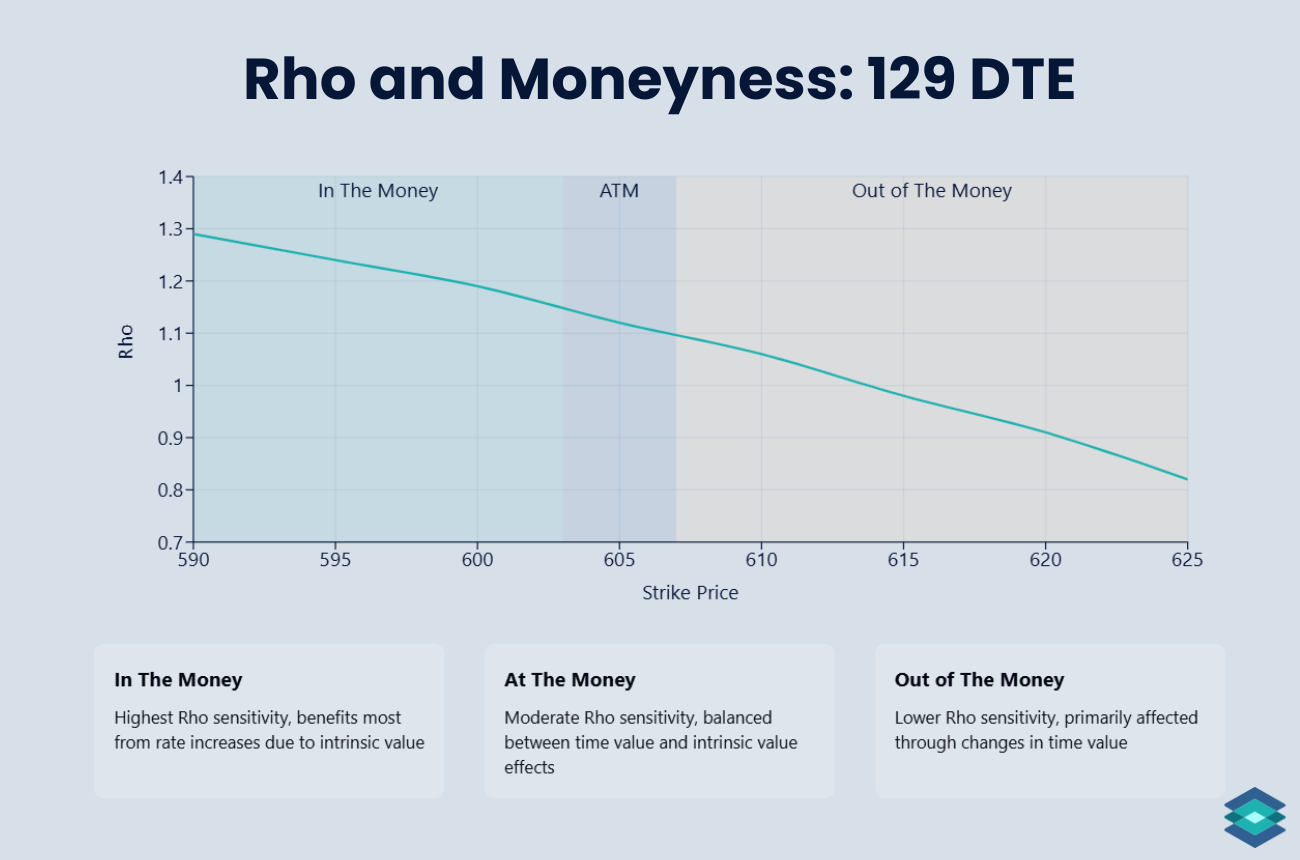
Rho measures how much an option's price changes with a 1% shift in interest rates. It has little impact on short-term options but plays a much bigger role in long-dated contracts, especially in-the-money options. When rates rise, calls gain value while puts lose value. The opposite happens when rates fall.

Rho doesn't impact most trades, but long-term options traders should pay attention when rates move. The further from expiration, the greater rho's impact.

Highlights
  • Interest Rate Sensitivity: Rho shows how option prices react to a 1% change in rates.
  • Stronger on Long-Dated: The further from expiration, the greater rho's impact.
  • Moneyness Matters: ITM options have higher rho. OTM options are less affected.
i
Pro Tip Rising rates make holding cash more attractive, which can subtly shift option pricing. Watch rho on any LEAPS position when the Fed is in motion.
Begin the Rho lesson
Module 2 · Knowledge check

Quiz: The Greeks

Five questions on price, time, and volatility sensitivity.

Score 0 / 5
Question 1 of 5
Which Greek measures an option's price sensitivity to a $1 move in the underlying?
WhyDelta measures price sensitivity. Gamma is delta's rate of change. Theta is time decay. Rho is interest rate sensitivity.
0%
0 out of 5 correct
Module Three
03

The 26 strategies library

Every options strategy worth knowing. Bullish, bearish, neutral, long volatility, and hedging. Each lesson opens to a full trade profile with max profit, max loss, breakeven, and the key risk metrics.

26 strategies · grouped by market view

Bullish

8 strategies
3.1 Long Call Bullish · Defined Risk · Debit Trade 10 min
Long call payoff diagram

The long call is the most basic bullish options strategy. You buy the right to buy the underlying at the strike price, and your maximum loss is capped at the premium paid. Upside is unlimited as the stock rallies.

Max Profit
Unlimited
Max Loss
Debit Paid
Breakeven
Strike + Debit
Time Decay
Unfavorable
Begin the Long Call lesson
3.2 Short Put Bullish · High Risk · Credit Trade 10 min
Short put payoff diagram

Sell a put below the market and collect the premium. Get paid to wait. If the stock stays above your strike, you keep the credit. If it doesn't, you get assigned shares at your strike. Common entry tactic for accumulating a stock you wanted to own anyway.

Max Profit
Premium
Max Loss
Substantial
Breakeven
Strike − Premium
Time Decay
Favorable
Begin the Short Put lesson
3.3 Covered Call Neutral to Bullish · Moderate Risk 11 min
Covered call payoff diagram

Sell calls against shares you already own. Income on top of a long stock position. At the cost of capping your upside if the stock runs above your strike. The most popular options income strategy in retail.

Max Profit
Premium + stock gain to strike
Max Loss
Stock − Premium
Breakeven
Stock − Premium
Time Decay
Favorable
Begin the Covered Call lesson
3.4 Bull Call Spread Bullish · Defined Risk · Debit Trade 11 min
Bull call spread payoff diagram

Buy a call, sell a higher-strike call against it. Defined risk, defined reward. Pay less than a long call, give up the moonshot. Solid trade for a moderately bullish view where you don't need unlimited upside.

Max Profit
Strike width − Debit
Max Loss
Debit Paid
Breakeven
Long strike + Debit
Time Decay
Unfavorable
Begin the Bull Call Spread lesson
3.5 Bull Put Spread Bullish · Defined Risk · Credit Trade 11 min
Bull put spread payoff diagram

Sell a put, buy a lower-strike put as protection. Theta-positive bullish trade with a hard floor on losses. Profitable as long as the stock stays above the short strike at expiration.

Max Profit
Credit Received
Max Loss
Strike width − Credit
Breakeven
Short strike − Credit
Time Decay
Favorable
Begin the Bull Put Spread lesson
3.6 LEAPS Call Bullish · Defined Risk · Long-Dated Debit 10 min
LEAPS call payoff diagram

Long-term equity calls. Typically expirations a year or more out. Stock-like exposure for a fraction of the capital. Less theta drag per day than short-dated calls because there's so much time to expiration. Often used as a stock surrogate for long-term bullish views.

Max Profit
Unlimited
Max Loss
Debit Paid
Breakeven
Strike + Debit
Time Decay
Unfavorable (slow)
Begin the LEAPS Call lesson
3.7 Poor Man's Covered Call (PMCC) Bullish · Defined Risk · Diagonal Debit 12 min
Poor man's covered call payoff diagram

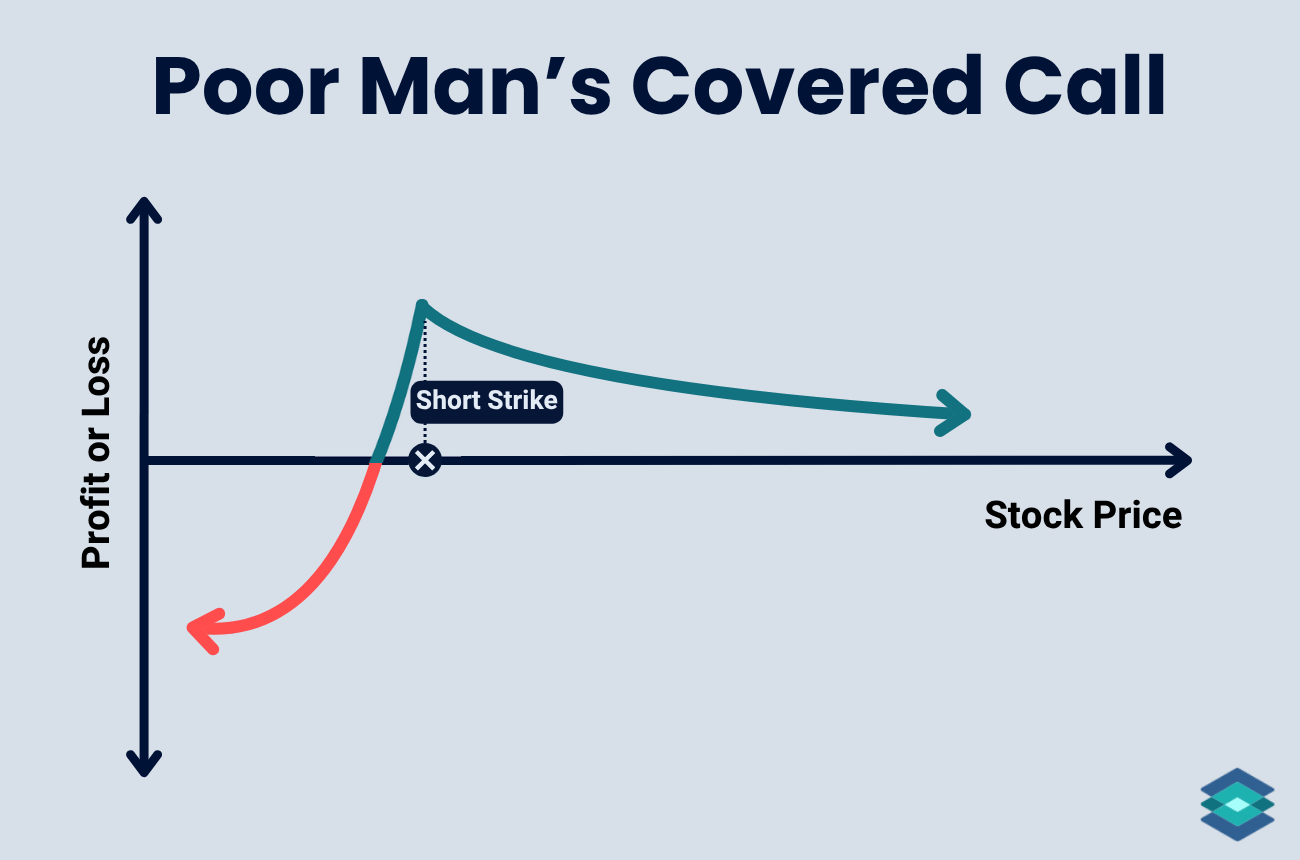
Use a deep ITM LEAPS call as your stock surrogate, then sell short-term calls against it like a covered call. Same income profile as a covered call, but for a fraction of the capital. Roll the short call each cycle.

Max Profit
Undefined
Max Loss
Debit Paid
Forecast
Bullish / Neutral
Time Decay
Favorable
Begin the PMCC lesson
3.8 Call Diagonal Spread Neutral to Bullish · Defined Risk · Debit Trade 11 min
Call diagonal spread payoff diagram

Long a back-month call, short a near-month call at a higher strike. Roll the short, ride the long. Profits from time decay differential. The front month bleeds faster than your long.

Max Profit
Undefined
Max Loss
Debit Paid
Forecast
Moderately Bullish
Time Decay
Favorable
Begin the Call Diagonal lesson

Bearish

7 strategies
3.9 Long Put Bearish · Defined Risk · Debit Trade 10 min
Long put payoff diagram

Buy the right to sell. Substantial profit potential as the underlying drops, with risk capped at the premium paid. The cleanest defined-risk way to express a bearish view.

Max Profit
Substantial
Max Loss
Debit Paid
Breakeven
Strike − Debit
Time Decay
Unfavorable
Begin the Long Put lesson
3.10 Short Call (Naked) Bearish · Unlimited Risk · Credit Trade 10 min
Short call payoff diagram

Sell premium above the market. Collect a credit if the stock stays below your strike. Maximum profit is the credit received. Maximum loss is unlimited if the stock rallies. Only run this with high margin and a strong directional view.

Max Profit
Premium
Max Loss
Unlimited
Breakeven
Strike + Premium
Time Decay
Favorable
Begin the Short Call lesson
3.11 Covered Put Neutral to Bearish · Unlimited Risk 10 min
Covered put payoff diagram

Short stock plus a short put. The mirror of a covered call. Income trade for a moderately bearish view, with margin requirements to short the stock.

Max Profit
Premium + stock gain to strike
Max Loss
Unlimited
Breakeven
Stock entry + Premium
Time Decay
Favorable
Begin the Covered Put lesson
3.12 Bear Put Spread Bearish · Defined Risk · Debit Trade 11 min
Bear put spread payoff diagram

Long a put, short a lower-strike put against it. Defined-risk bearish play with a discounted entry cost vs. a long put. Cap upside, cap downside, take a moderate bearish view with controlled exposure.

Max Profit
Strike width − Debit
Max Loss
Debit Paid
Breakeven
Long strike − Debit
Time Decay
Unfavorable
Begin the Bear Put Spread lesson
3.13 Bear Call Spread Bearish · Defined Risk · Credit Trade 11 min
Bear call spread payoff diagram

Sell a call, buy one further OTM as protection. Theta-positive bearish trade with hard-capped risk. Profitable as long as the stock stays below the short strike at expiration.

Max Profit
Credit Received
Max Loss
Strike width − Credit
Breakeven
Short strike + Credit
Time Decay
Favorable
Begin the Bear Call Spread lesson
3.14 LEAPS Put Bearish · Defined Risk · Long-Dated Debit 10 min
LEAPS put payoff diagram

Long-term puts. Hedge a portfolio for months, or express a slow-burn bearish thesis. Lower theta per day than short-dated puts, but expensive in dollar terms.

Max Profit
Substantial
Max Loss
Debit Paid
Breakeven
Strike − Debit
Time Decay
Unfavorable (slow)
Begin the LEAPS Put lesson
3.15 Put Diagonal Spread Neutral to Bearish · Defined Risk · Debit Trade 11 min
Put diagonal spread payoff diagram

Long a back-month put, short a near-month put at a lower strike. Time-decay tailwind on a moderately bearish bias. Roll the short, hold the long.

Max Profit
Undefined
Max Loss
Debit Paid
Forecast
Moderately Bearish
Time Decay
Favorable
Begin the Put Diagonal lesson

Market Neutral

6 strategies
3.16 Short Straddle Neutral · Unlimited Risk · Credit Trade 11 min
Short straddle payoff diagram

Sell a call and put at the same strike. Maximum credit, maximum theta, and unlimited risk if the underlying makes a big move in either direction. The most aggressive theta-positive trade.

Max Profit
Credit Received
Max Loss
Unlimited
Breakevens
Strike ± Credit
Time Decay
Favorable
Begin the Short Straddle lesson
3.17 Short Strangle Neutral · Unlimited Risk · Credit Trade 11 min
Short strangle payoff diagram

Sell an OTM call and an OTM put. Wider profit zone than a short straddle, smaller credit, same unlimited risk profile. Common entry for premium sellers in elevated IV.

Max Profit
Credit Received
Max Loss
Unlimited
Breakevens
Upper + Credit / Lower − Credit
Time Decay
Favorable
Begin the Short Strangle lesson
3.18 Iron Butterfly Neutral · Defined Risk · Credit Trade 12 min
Iron butterfly payoff diagram

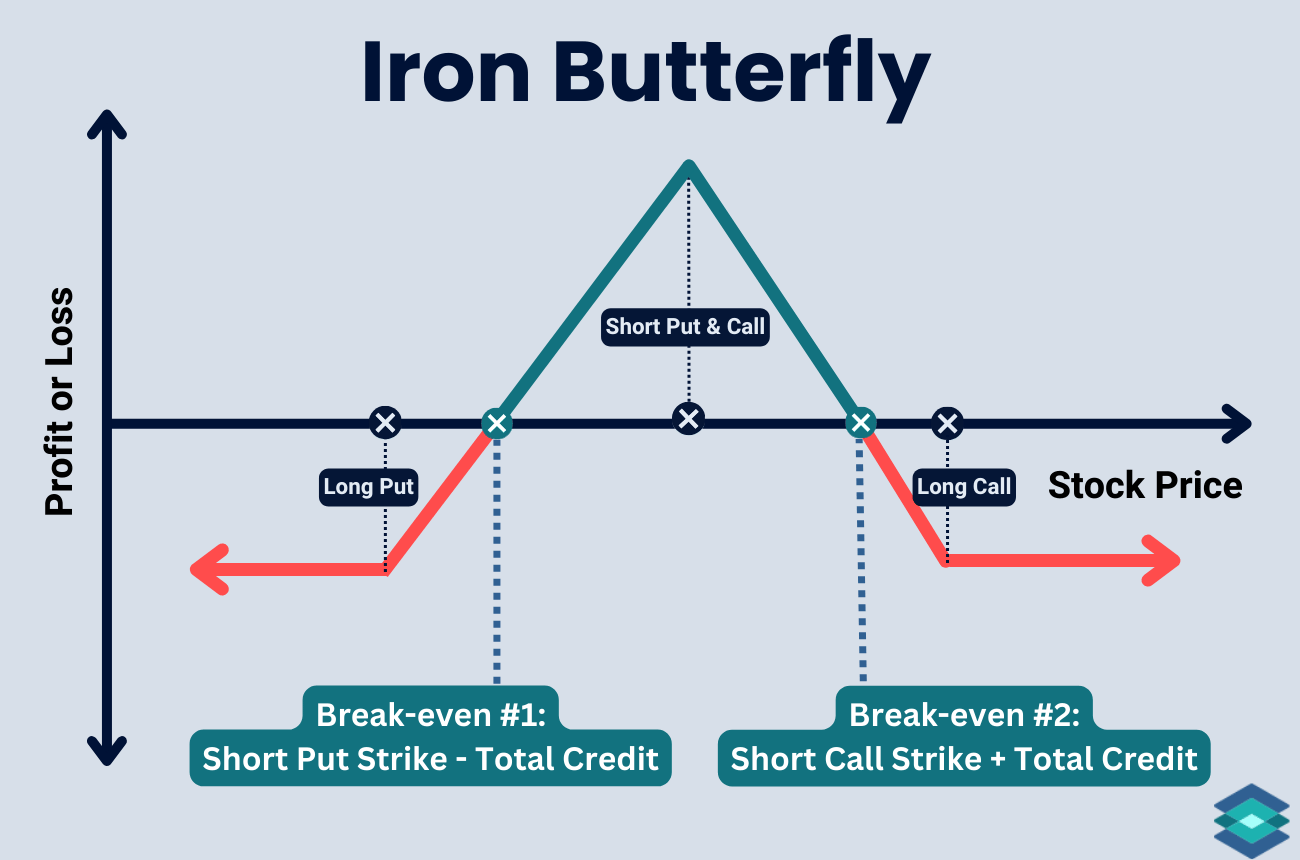
A short straddle with wings. Same theta-positive idea as a straddle, but with a hard cap on max loss thanks to the long protective options. Pin-the-tail-on-the-strike with defined downside.

Max Profit
Credit Received
Max Loss
Wing width − Credit
Breakevens
Short strike ± Credit
Time Decay
Favorable
Begin the Iron Butterfly lesson
3.19 Butterfly Neutral · Defined Risk · Debit Trade 11 min
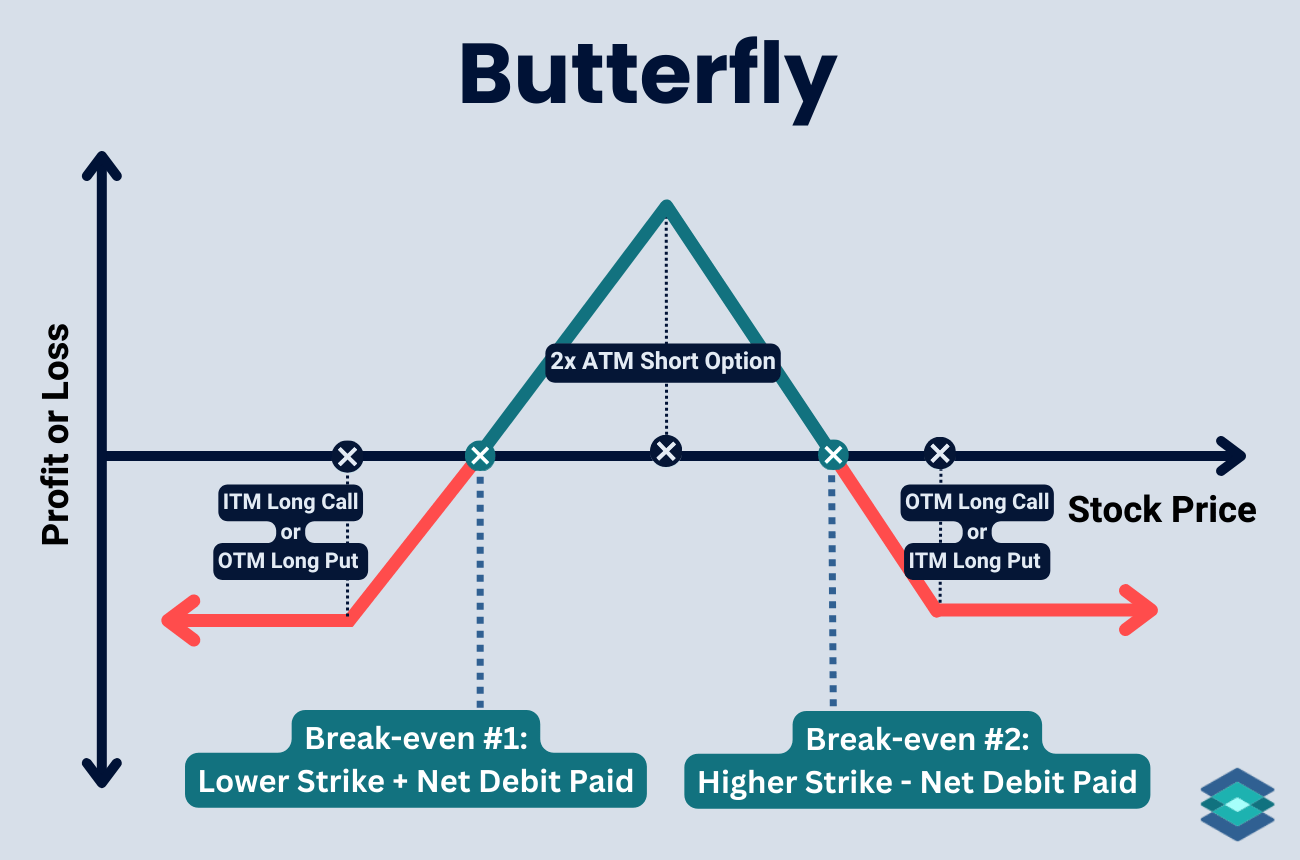
Long butterfly payoff diagram

Pin-the-tail-on-the-strike. Cheap to put on, with a big payout if the underlying lands at your middle strike at expiration. Low probability, high reward. A precision trade.

Max Profit
Spread width − Debit
Max Loss
Debit Paid
Breakevens
Lower + Debit / Upper − Debit
Time Decay
Favorable
Begin the Butterfly lesson
3.20 Short Iron Condor Neutral · Defined Risk · Credit Trade 12 min
Short iron condor payoff diagram

The flagship range-bound trade. Sell a call spread above and a put spread below. Cap risk on both sides, profit if the underlying stays in the middle. The single most popular defined-risk premium-selling strategy.

Max Profit
Credit Received
Max Loss
Strike width − Credit
Breakevens
Short call + Credit / Short put − Credit
Time Decay
Favorable
Begin the Iron Condor lesson
3.21 Calendar Spread Neutral · Defined Risk · Debit Trade 12 min
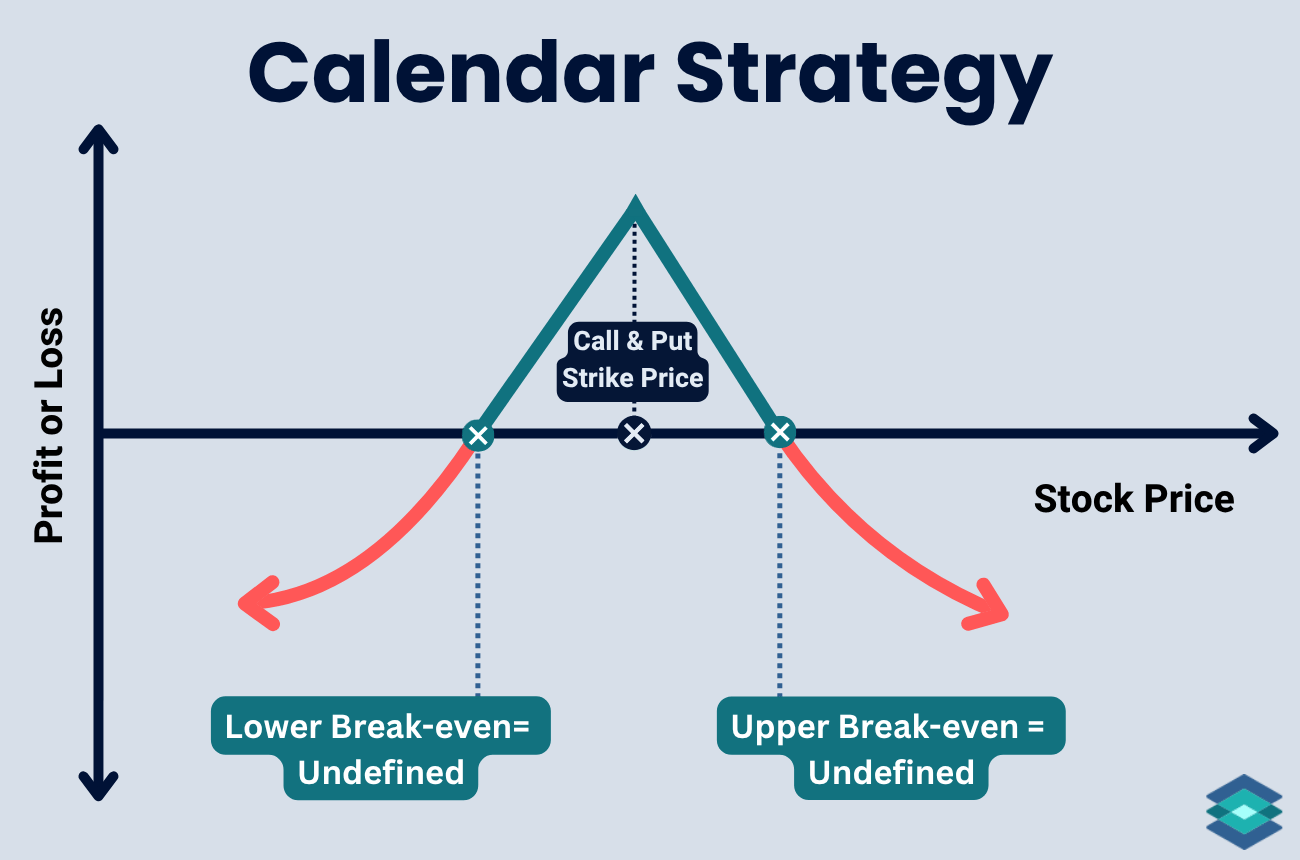
Calendar spread payoff diagram

Sell a near-term option, buy the same strike in a later cycle. Profits from theta differential and IV term structure. Excellent trade when you expect the underlying to pin a strike with rising back-month IV.

Max Profit
Undefined
Max Loss
Debit Paid
Breakeven
Not fixed
Time Decay
Favorable
Begin the Calendar Spread lesson

Long Volatility

3 strategies
3.22 Long Straddle Volatile · Defined Risk · Debit Trade 11 min
Long straddle payoff diagram

Buy a call and a put at the same strike. You don't care which way it moves. You care that it moves big enough to overcome the combined cost. Common around earnings, FOMC, or any binary event.

Max Profit
Unlimited
Max Loss
Debit Paid
Breakevens
Strike ± Debit
Time Decay
Unfavorable
Begin the Long Straddle lesson
3.23 Long Strangle Volatile · Defined Risk · Debit Trade 11 min
Long strangle payoff diagram

OTM version of the straddle. Cheaper to put on, but the underlying needs to move further to pay off. Better risk/reward in absolute terms, harder to win on.

Max Profit
Unlimited
Max Loss
Debit Paid
Breakevens
Upper + Debit / Lower − Debit
Time Decay
Unfavorable
Begin the Long Strangle lesson
3.24 Long Iron Condor Volatile · Defined Risk · Debit Trade 12 min
Long iron condor payoff diagram

Buy the move, cap the cost. A defined-risk way to express a "something's gotta give" view. Usually before earnings or a known event. The mirror of a short iron condor.

Max Profit
Strike width − Debit
Max Loss
Debit Paid
Breakevens
Long call + Debit / Long put − Debit
Time Decay
Unfavorable
Begin the Long Iron Condor lesson

Hedging

2 strategies
3.25 Protective Put Hedging · Defined Risk · Bullish 9 min
Protective put payoff diagram

Insurance for a long stock position. Pay a premium for downside protection while keeping full upside on the stock. The cleanest hedge there is, and the most expensive when nothing happens.

Max Profit
Unlimited
Max Loss
(Stock − Strike) + Premium
Breakeven
Stock + Premium
Time Decay
Unfavorable
Begin the Protective Put lesson
3.26 Collar Hedging · Defined Risk · Neutral to Bullish 10 min
Collar payoff diagram

Long stock, long protective put, short call. Cap upside to fund the downside protection. Often net zero cost. The institutional-grade hedge for concentrated stock positions.

Max Profit
Call strike − Stock ± Premium
Max Loss
Stock − Put strike ± Premium
Breakeven
Stock cost ± Premium
Time Decay
Slightly Favorable
Begin the Collar lesson
Module 3 · Knowledge check

Quiz: Strategies

Test your read on payoff profiles, risk, and market views.

Score 0 / 5
Question 1 of 5
A short iron condor reaches max profit when:
WhyIron condors are range-bound trades. Max profit is the credit, achieved when the underlying expires between the two short strikes.
0%
0 out of 5 correct
Module Four
04

Free option calculators

Take what you've learned and run the numbers. Every calculator is free, no signup, no email gate. Visualize max profit, max loss, breakevens, and the Greeks before you put a dollar on the line.

10 calculators · all browser-based
4.1 Options Breakeven Calculator Visualize breakevens, max profit, and max loss for 18 strategies in one tool.

The most comprehensive options calculator in the suite. Pick from any of 18 core strategies. Verticals, condors, butterflies, straddles, strangles, and see the payoff diagram, breakeven points, and max risk/reward instantly. Numerical zero-crossing approach handles every shape correctly.

Open calculator
4.2 Probability of Profit Calculator Black-Scholes lognormal probability. What are your real odds?

Find out the likelihood your trade lands in profit at expiration based on the underlying's implied volatility and days to expiration. Built on the Black-Scholes lognormal distribution. Particularly useful for evaluating short premium trades.

Open calculator
4.3 Option Greeks Calculator Delta, gamma, theta, and vega for any strike. Plug in inputs, see the risk profile.

The Greeks calculator is the perfect companion to Module 2. Input strike, expiration, underlying price, and IV. Get back delta, gamma, theta, and vega instantly. Useful for sizing positions and understanding risk before clicking "place order."

Open calculator
4.4 Long Call Calculator Profit, loss, and breakeven for any long call setup, with full payoff visualization.

Single-leg long call analyzer. Input strike, premium, and expiration. See the payoff curve, breakeven, and max loss. Great for sanity-checking a directional bet before placing it.

Open calculator
4.5 Long Put Calculator Visualize the payoff of a long put. Profit zone, breakeven, and the cost of being early.

Single-leg long put analyzer. See exactly how far the underlying needs to drop to break even, and how much you stand to make if your bearish thesis plays out.

Open calculator
4.6 Short Call Calculator Naked short call P&L. See where the unlimited-risk side starts cutting in.

Visualize the asymmetric profile of a naked short call. Capped upside (the credit), uncapped downside as the stock rallies. Critical to see this drawn out before you ever sell one uncovered.

Open calculator
4.7 Short Put Calculator Premium captured vs. assignment risk. Visualize the trade before you sell the put.

Run the numbers on a cash-secured put. See max profit (the credit), max loss (strike minus premium), and the breakeven where you'd be assigned at a worse-than-market basis.

Open calculator
4.8 Covered Call Calculator Run the numbers on writing calls against your stock. Yield, breakeven, called-away outcomes.

Built for stockholders thinking about generating income. Input your stock basis, the strike of the call you're considering, and the premium. See annualized yield, breakeven, and what happens if you get called away.

Open calculator
4.9 Vertical Spread Calculator Bull and bear spreads for calls and puts in one place. Risk/reward in seconds.

The four-in-one vertical spread tool: bull call, bear call, bull put, bear put. See max profit, max loss, breakeven, and the payoff curve for any strike combination you're considering.

Open calculator
4.10 Iron Condor Calculator Profit zones, max loss, and breakeven for the most-traded neutral strategy.

Configure the four legs (short call, long call, short put, long put) and see the iron condor's classic two-shouldered payoff curve. Adjust strikes to find the sweet spot of credit collected vs. width of the profit zone.

Open calculator
Module Five
05

Advanced deep dives

Once you've got the basics down, this is where the real edge lives. 0DTE mechanics, IV rank vs IV percentile, gamma exposure, margin frameworks, and the volatility products most traders get wrong.

7 lessons · advanced
5.1 0DTE Options: 7 Strategies and When to Use Them Long calls/puts, credit spreads, iron condors. The seven setups that work on a same-day expiration tape. 14 min

0DTE. Zero days to expiration. Is the fastest-growing segment of the options market. Same-day expirations on SPY, SPX, QQQ, and major single-names create unique risk profiles where gamma is enormous and theta is collected in hours, not weeks. This guide breaks down seven core 0DTE strategies including long calls and puts, credit spreads, and iron condors.

Begin the 0DTE Strategies lesson
5.2 SPY vs SPX 0DTE: 7 Critical Differences Settlement, tax treatment, contract size, margin. The seven things that decide which one fits your trade. 9 min
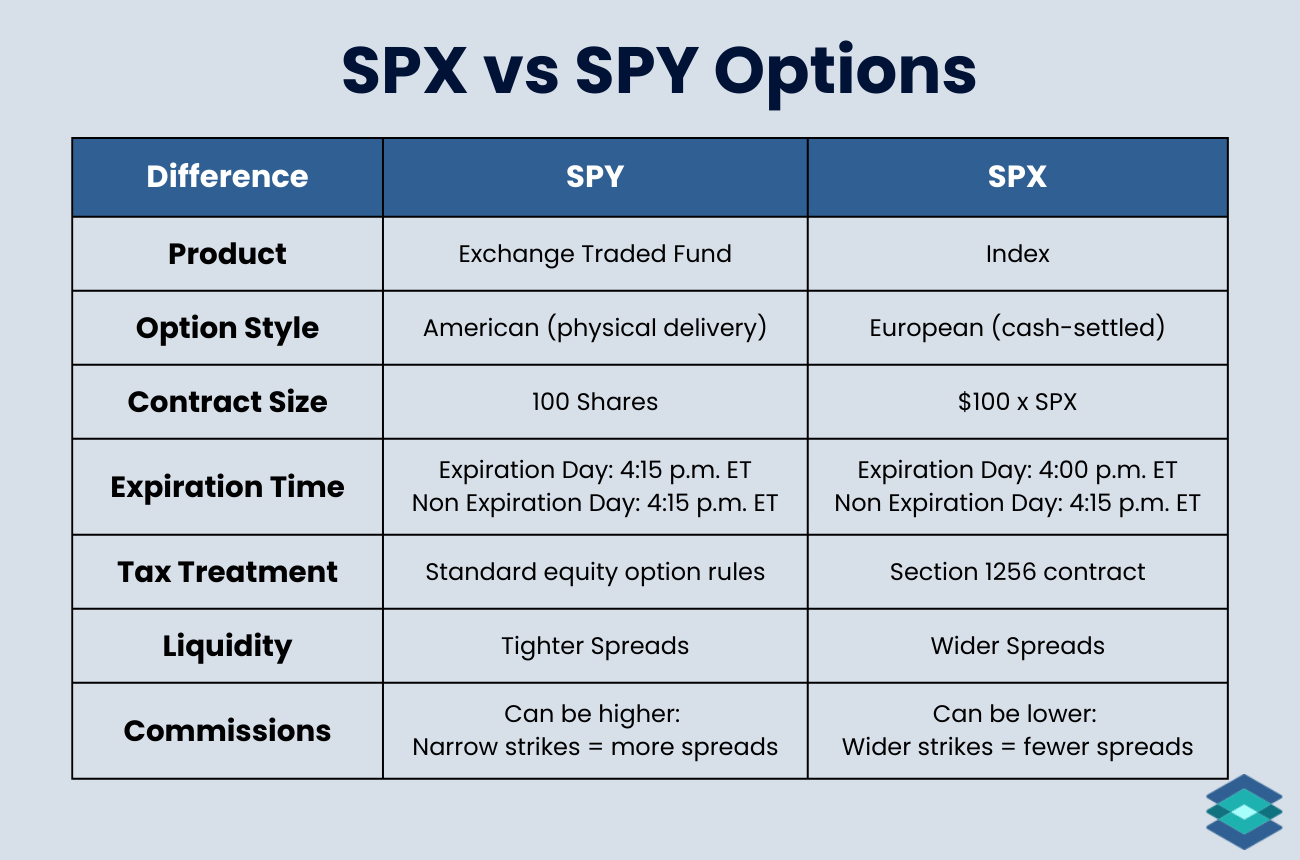
SPX vs SPY options comparison

SPY and SPX both track the S&P 500, but they're radically different products. SPX is European-style, cash-settled, and has 1256 tax treatment. SPY is American-style, physically settled, and taxed as ordinary equity. Plus contract size, dividends, settlement times. Each difference shapes the right tool for the trade.

Begin the SPY vs SPX lesson
5.3 IV Rank vs IV Percentile: Which Is Best? Two ways of looking at the same number. Knowing which to use is half the battle. 8 min
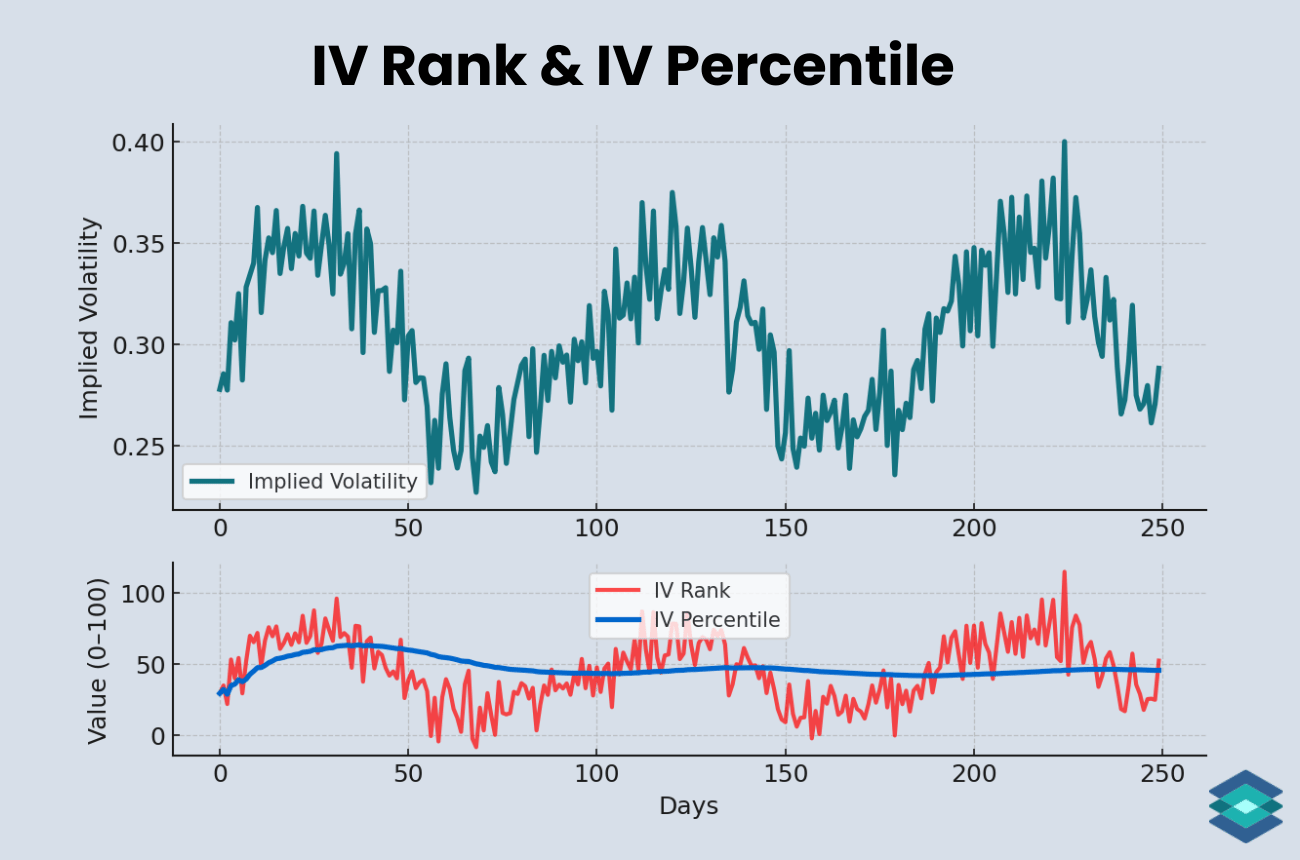
IV Rank vs IV Percentile illustration

IV Percentile shows how often implied volatility has been lower than today's level over the past year. A frequency measure. IV Rank shows where today's IV falls between the highest and lowest levels of the past year. A placement measure. Both are useful, but they tell different stories. Knowing when to use which is a key skill for any premium seller.

Begin the IV Rank lesson
5.4 Long Gamma vs Short Gamma: Beginner's Guide Why long gamma loves big moves and short gamma needs the tape to stay quiet. 10 min
Option gamma distribution chart

Long gamma positions. Long calls, long puts, debit spreads. Benefit from big moves but lose value to time decay. Short gamma positions. Short options, credit spreads. Profit when prices stay steady but take losses quickly when the market moves. Understanding which side you're on is the difference between making money and getting steamrolled.

Begin the Long vs Short Gamma lesson
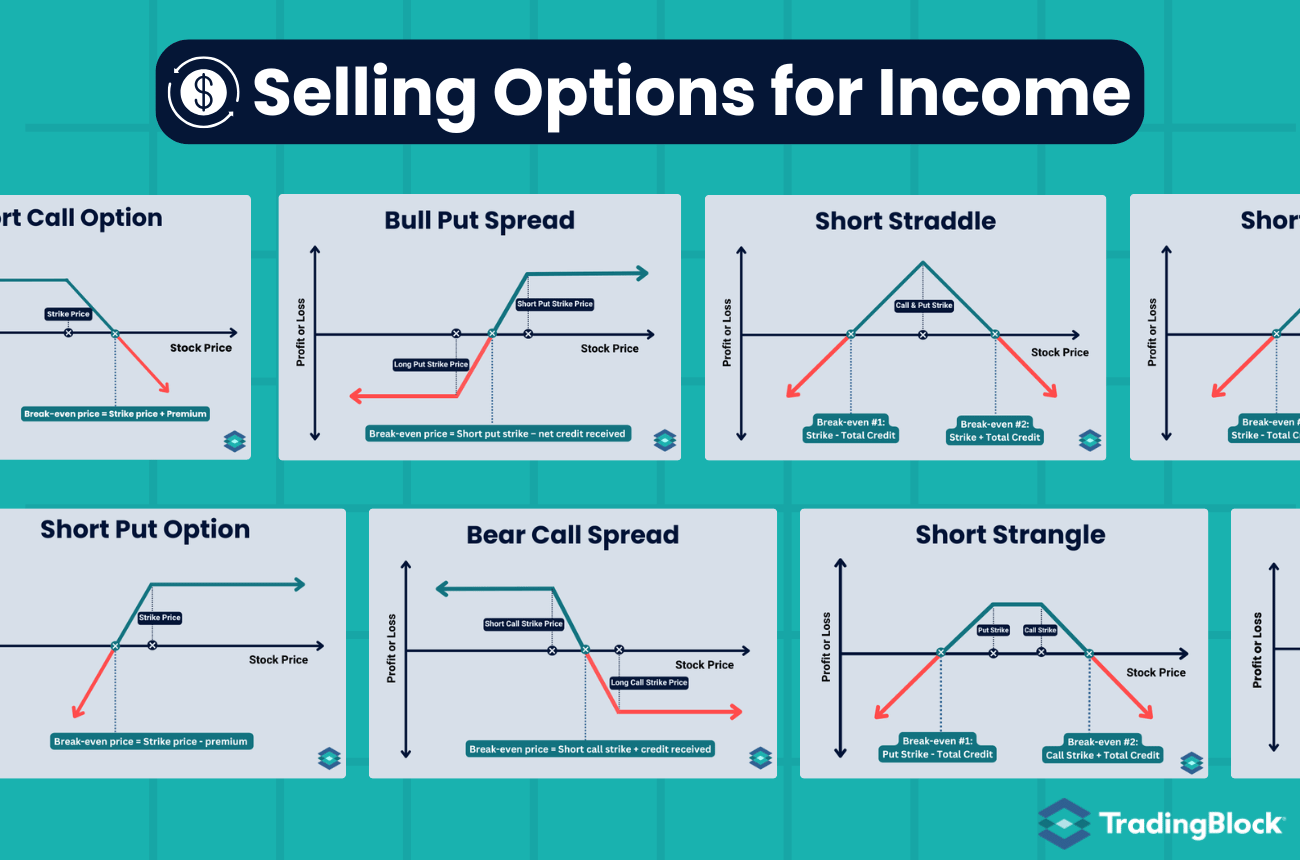
5.5 Selling Options for Income: Top 5 Strategies The five approaches to monetize theta: naked options, credit spreads, covered calls and puts, cash-secured puts, and short straddles and strangles. 13 min
Selling options for income strategy

Selling options to generate income is the core of premium-selling strategies. The five approaches: selling options naked, credit spreads (defined risk), covered calls and covered puts, cash-secured puts, and short straddles and strangles. They all share one thing: they profit from time decay. This guide breaks down how each works, when to use it, and the risks that come with collecting credit.

Begin the Selling for Income lesson
5.6 VXX vs VIX Options: Key Differences Two volatility products, two completely different risk profiles. Which to use, which to leave alone. 10 min
VIX vs VXX options comparison

VXX is an ETN that tracks VIX futures and bleeds value over time when the futures curve is in contango, which is most of the time. VIX options price off VIX futures, not the spot VIX index, and are European-style and cash-settled. Many traders assume the two behave the same way when in reality their structures and risk profiles are completely different. This guide covers structure, settlement, where the risk hides, and which is better suited for short-term trading vs. longer-term hedging.

Begin the VXX vs VIX lesson
5.7 Reg T vs Portfolio Margin: Which Is Best for You? Why active traders graduate to portfolio margin, and what it actually changes. 12 min
Reg T vs Portfolio Margin requirements

Regulation T (Reg T) sets fixed margin requirements for each individual position. Portfolio margin adjusts based on a portfolio's overall risk. Accounting for offsetting positions and net exposure. Because of this, portfolio margin accounts allow for greater leverage and lower margin requirements. The catch: $125K minimum equity, options approval, and a much higher bar for risk management.

Begin the Reg T vs PM lesson
Module 5 · Knowledge check

Quiz: Advanced Topics

0DTE, IV metrics, margin frameworks, and volatility products.

Score 0 / 5
Question 1 of 5
0DTE options are characterized by:
WhySame-day expirations carry massive gamma. Small underlying moves cause huge percentage swings. They can flip from worthless to deep ITM in minutes.
0%
0 out of 5 correct

Course FAQ

The questions we get most from traders working through the curriculum.

Is this course really free?
Yes. Every lesson, every strategy guide, every calculator. No email gate, no paywall, no upsell. Open a live account if you want to actually trade, but you don't need to in order to learn.
Do I need to take the modules in order?
If you're brand new, follow the curriculum top to bottom. Module 1 → Module 2 → Module 3 will give you the foundation everything else builds on. If you already trade, jump straight to strategies or deep dives.
How long does the full course take?
About 4–6 hours of focused reading. The fundamentals and Greeks modules are the most reading-intensive. The strategies module is more reference. You'll come back to it often once you start trading. Use the Virtual Trading environment to practice between lessons.
What's the best options strategy for a beginner?
Start with defined-risk: a long call or long put for directional bets, a vertical spread for a more measured view. Avoid naked short options until you understand the Greeks and margin requirements cold.
Who writes this content?
Michael Martin, VP of Market Strategy at TradingBlock. He's a Registered Options Principal (ROP) with 15+ years as an options broker, with prior roles at thinkorswim, TD Ameritrade, and Charles Schwab. The content is fact-checked by additional licensed staff.

Ready to put it into practice?

Open a TradingBlock account and trade options on a CBOE-rooted platform built for active traders. Or test drive it risk-free in our Virtual Trading environment with real market data.

Leaving?

You are about to leave tradingblock.com and visit youtube.com/@TradingBlockTV/Videos. Continue?

close