What Are 0DTE Options? Complete Trading Guide
A zero days to expiration (0DTE) option is just a regular options contract with one difference: it expires today. You’re trading something with only hours left, so everything moves faster, and outcomes come quickly.
.png)
With 0DTE options, time decay hits immediately and premium erodes throughout the session. Small moves in the underlying can quickly shift delta and change the outcome of the trade. As expiration approaches, options tend to move toward either intrinsic value or zero.
Highlights
What are Zero Days to Expiration (0DTE) Options?
0DTE options are like all other options with one key difference: they expire today. In theory, every option becomes 0DTE at some point since all options have an expiration date. 0DTE options are popular because they are extremely sensitive to time.
Think of it this way. If you own an at-the-money 100 strike price call option on ABC (trading at $100/share) expiring in one year, it’s not going to react all that much to small moves in the stock today. You have 365 days until expiration.
Now compare that to a $100 strike call on ABC expiring in one hour. That option basically has a 50/50 shot of finishing in the money (with intrinsic value) or out of the money (worthless). Every small move matters.
.png)
Volatility is everything here. For example, stocks that don’t move much have a lower probability of jumping above or falling below $100 in the final hours, so premiums will be low.
With a high beta tech stock, where implied volatility is sky high, that same option will carry a much higher premium. The moves are bigger, and so are the potential gains and losses.
How Do 0DTE Options Work?
0DTE options trade like any other option, but everything is compressed into hours instead of days or weeks. Time decay (represented by the options Greek ‘theta’) hits immediately. Premium erodes in real-time.
Price becomes more binary as expiration approaches. Options tend to move toward either intrinsic value or zero, with very little in between.
Small moves drive outsized reactions. With no time left, even a modest move in the underlying can completely change the outcome.
- Gamma ramps up: delta can shift quickly, so exposure changes fast
- Theta is constant pressure: time decay is always working against buyers
- Execution matters: tight windows make liquidity and spreads more important
At a high level, you’re not trading long-term direction but what happens next, with very little room for error!
Why are 0DTE Options Popular?
0DTE options are popular because you get immediate feedback. The trade either works or it doesn’t, and it happens today.
- Immediate outcomes: You know quickly if you’re right or wrong, which is appealing for active traders.
- High sensitivity: Small moves in the underlying can create outsized percentage gains or losses.
- Capital efficiency: Defined-risk trades can offer meaningful exposure with relatively small upfront capital.
For many retail traders, 0DTE options are akin to gambling and not trading or investing. For example, if an at-the-money call option on a $100 stock has a delta of around 0.50, that implies roughly a 50/50 shot of finishing in the money by expiration. With only hours left, every small move in the stock can swing the outcome dramatically, turning the trade into more of a coin flip
With that said, you can invoke some strategy here. Traders may use 0DTE options to hedge an existing position for a specific event or trading session, or try to capitalize on rapid time decay when conditions line up. But the margin for error is extremely small, so without a clear plan around entry, exit, strike selection, and risk, 0DTE trading can quickly drift back into gambling.
When Should You Trade 0DTE Options?
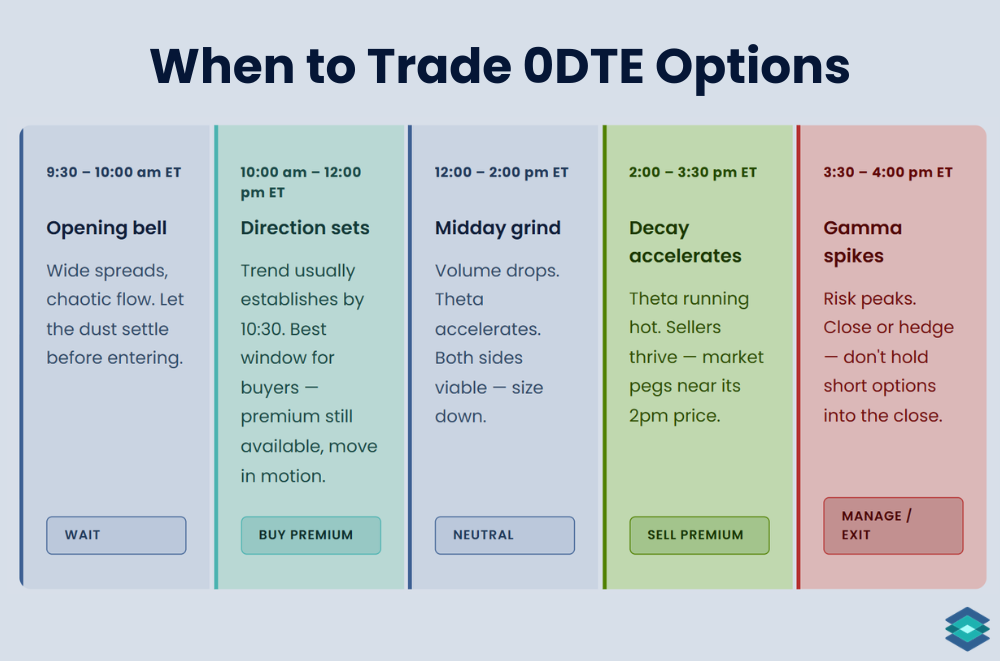
If we’re talking 0DTE options, we’re obviously talking about trading options on the day they expire. With that said, some traders do see a strategy around when to trade, based on whether they’re buying or selling premium.
- Buying options: Earlier in the day or into a catalyst. You need the move now.
- Selling options: Later in the day. Let time decay do the work.
- Post-open: Let the first move settle, then trade once volatility calms down and a direction is set.
0DTE Options: Delta and Gamma

In options trading, the Greeks are a series of risk metrics that show how an option’s price changes as different variables move. On 0DTE, two matter more than anything else: delta and gamma.
Delta measures your directional exposure and how much an option’s price is expected to move with the underlying. At the money options tend to have deltas around 0.50, while in the money options have higher deltas (closer to 1.00 for calls, -1.00 for puts) and out of the money options have lower deltas (closer to 0).
On 0DTE, delta also shifts quickly as the underlying moves, especially near the strike. That means your position can go from low exposure to highly directional fast. If you’re long options, you need delta to increase in your favor quickly.
Gamma is what makes 0DTE a different game entirely. Gamma measures how fast delta changes, and on expiration day, it spikes. That means your position can flip on you very quickly. An option that looks safe in the morning can become highly directional by the afternoon. If you’re long, gamma is your friend. A small move can turn into a big win. If you’re short, gamma is the risk. That same small move can accelerate losses before you have time to react. That’s why 0DTE trading feels fast. It is.
0DTE Options: Assignment and Exercise
Options contracts are either settled American or European style. That distinction matters alot with 0DTE options.
American-style options (stocks and ETFs) can be exercised or assigned at any time, including before expiration. European-style options (most index options) can only be exercised at expiration.
With European-style, cash-settled index options, there’s no early assignment risk and no shares changing hands. Everything settles in cash at the close.
With American-style stock and ETF options, you’re dealing with physical settlement.
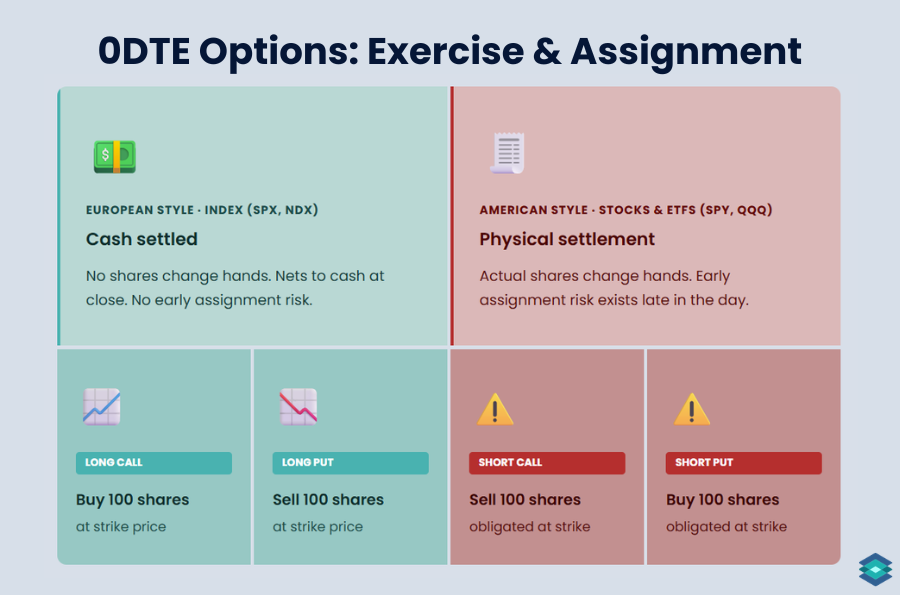
If you’re long an in the money option into expiration, you’ll typically be auto-exercised by your broker:
- Long call → you buy 100 shares per contract (at strike price)
- Long put → you sell 100 shares per contract
If you’re short an in the money option, you’re at risk of assignment:
- Short call → you’re obligated to sell 100 shares
- Short put → you’re obligated to buy 100 shares
Late in the day, this risk becomes very real. That’s why most 0DTE traders close positions before expiration.
0DTE Options and Liquidity
Liquidity is everything with 0DTE. You want heavy trading in the underlying ETF or stock, and deep, active options markets on top of that.
In the options market, you’re looking for:
- Tight spreads
- High volume and open interest
- Real size on the bid/ask
0DTE Option: 5 Popular Products
Here are a few of the most liquid and popular products to trade 0DTE options in.
Indices (European-style, cash-settled)
- SPX (S&P 500)
- NDX (Nasdaq 100)
These are the cleanest for 0DTE. No early assignment, no shares, just cash settlement at the close.
ETFs (American-style, physically settled)
- SPY (S&P 500 ETF)
- QQQ (Nasdaq 100 ETF)
These trade just as actively, but you’ve got assignment risk if you hold into expiration. You can read more about the difference between SPY and SPX here.
5 0DTE Option Strategies
We wrote a comprehensive article on 7 popular 0DTE option strategies. Here are our top five from that list, summed up:
1. Long options: This is the pure directional bet. You’re buying a call or put because you think the market is going to move, and move soon. On 0DTE, there’s no time to be early. You’re either right quickly, or the option bleeds out.
- You need momentum: Slow moves won’t cut it.
- Cheap can be misleading: Low premium often = low probability.
- Gamma works for you: If it goes your way, it can go fast.
2. Short options: Now you’re on the other side, selling premium (shorting calls and puts) and letting time decay do the work. This is how a lot of pros approach 0DTE, but the risk is real if things get out of hand.
- Theta is your edge: Time decay accelerates into the close.
- Small wins stack: You’re not swinging, you’re waiting and collecting.
- Risk can expand fast: One bad move can wipe out multiple wins.
3. Short vertical spreads: Selling call spreads and selling put spreads is a defined-risk way to sell premium. You’re still directional, but you’re reducing exposure by capping both risk and reward.
- Defined risk: max loss is known upfront
- Premium seller: you benefit from time decay
- Capped upside: profits are limited to the credit received
4. Short iron condor: The short iron condor is a range trade. You’re selling both sides and betting the market stays within a window through expiration.
- You want nothing to happen: Quiet markets are ideal.
- Two ways to be wrong: Risk on both sides.
- Premium driven: Works best when volatility is slightly elevated.
5. Straddles and strangles: Both the short straddle and strangle involve selling a call option and put option naked. You’re betting the market doesn’t move as much as options are pricing in.
- Delta neutral: not leaning directionally to start (depending on setup)
- Wide vs tight: strangles give more room, straddles collect more premium
- Active management: positions can shift quickly and need close monitoring
0DTE Options: 4 Major Risks
0DTE options trading is a risky business. Here are a few of the more paramount risks all traders should know before trading these highly volatile contracts:
- Gamma risk: Positions can flip fast. What looks safe can become very dangerous in minutes.
- Time decay (theta): Premium disappears quickly. If you’re long, you’re fighting the clock all day.
- Liquidity risk: Spreads can widen, especially in fast markets or less active strikes.
- Execution risk: You may only have seconds to act. Bad fills can turn a winner into a loser.
0DTE vs Non-0DTE Options
⚠️ 0DTE options are high risk and not suitable for all investors. With only hours to expiration, losses can occur quickly and positions can change rapidly. Short premium strategies can carry substantial risk, including losses that exceed initial credit received. Always have a defined plan for entry, exit, and risk before trading.
FAQ
0DTE (zero days to expiration) options decay quickly due to their high time sensitivity.
Not long. These trades are fast-moving. Many traders manage them within minutes or hours. Holding until expiration can work, but it adds risk, especially with near the money options.
0DTE trading can drive intraday volatility. When large positions need to be hedged, especially around key price levels, it can amplify moves and create sharp reversals.
The best 0DTE options strategy depends on your market outlook. If you expect a big move, net debit strategies like long calls or puts may work. If you expect the market to stay put, selling premium can make take advantage of time decay. Think short puts, short iron condors, or short straddles.


.png)