What Is a Margin Account? Margin Trading Rules for Stocks and Options
With stocks, margin is a loan from your broker, usually up to 50% of the purchase. With options, margin is collateral. Regulators set the minimums. Your broker can require more, and can raise its requirements at any time.
A margin account lets you borrow from your broker and trade options strategies a cash account can't hold. Federal, FINRA and exchange rules set how much you can borrow and how much equity you must keep. Here is how those rules work for stocks and options.
Highlights
- Two meanings: Margin is a loan when you buy stock and collateral when you short stock and sell options.
- Stock rules: Reg T lets you borrow up to 50%. FINRA requires $2,000 to start and 25% equity after.
- Options rules: Buyers pay in full. Spreads require their max loss. Uncovered options use various formulas
- PDT rule gone: Since June 4, 2026, intraday requirements match overnight requirements.
- Real risk: Brokers can sell your positions to meet a call, and you can lose more than you deposit.
After about 20 years on options desks at thinkorswim, TD Ameritrade, Schwab and now TradingBlock, I can tell you most margin questions come down to buying power and margin calls. Here are the rules behind both.
What Is a Margin Account?
A margin account lets you borrow from your broker, using the cash and securities in the account as collateral. You sign a margin agreement to open one. It lets the broker charge interest and sell your positions if the account falls below its requirements.
Your equity is what you would have if you closed everything and repaid the loan: market value plus cash, minus what you owe.
A margin account lets you:
- Borrow up to 50% to buy marginable stocks and ETFs.
- Sell stock short.
- Trade spreads and naked calls and puts, with the right options approval.
- Use sale proceeds right away, without waiting for settlement.
Cash Account vs Margin Account
A cash account pays for everything with settled cash. Trades settle one business day after the trade date (T+1), and buying with unsettled funds can trigger a good faith violation.
Limited Margin in IRAs
IRAs can’t borrow money, but TradingBlock offers limited margin in IRAs. Limited margin gives you some margin account features with no borrowing and no margin interest.
- What it allows: Covered calls, cash-secured puts, and defined-risk spreads such as verticals.
- What it doesn’t allow: Borrowing, carrying a debit balance, shorting stock or selling uncovered options.
- Minimum equity: $2,000.
- Cash-secured puts: The account sets aside enough cash to buy the shares if you’re assigned.
- Exercise and assignment: You need enough cash to cover exercise before expiration, or positions can be closed without notice.
- Index spreads: Spreads on American-style cash-settled indexes and calendar spreads on any cash-settled index aren’t allowed.
Talk to a tax advisor first. A debit balance or a short position you don’t close quickly can be treated as a taxable distribution from the IRA. Compare TradingBlock’s account types.
Margin Rules for Stocks
The Federal Reserve's Regulation T (Reg T) sets how much you can borrow up front. FINRA Rule 4210 sets the equity you must keep afterward. Brokers can add stricter house requirements on top.
Low-priced stocks, recent IPOs and some leveraged ETFs may not be marginable at all, which means you pay 100%.
Example: Buying ABC on Margin
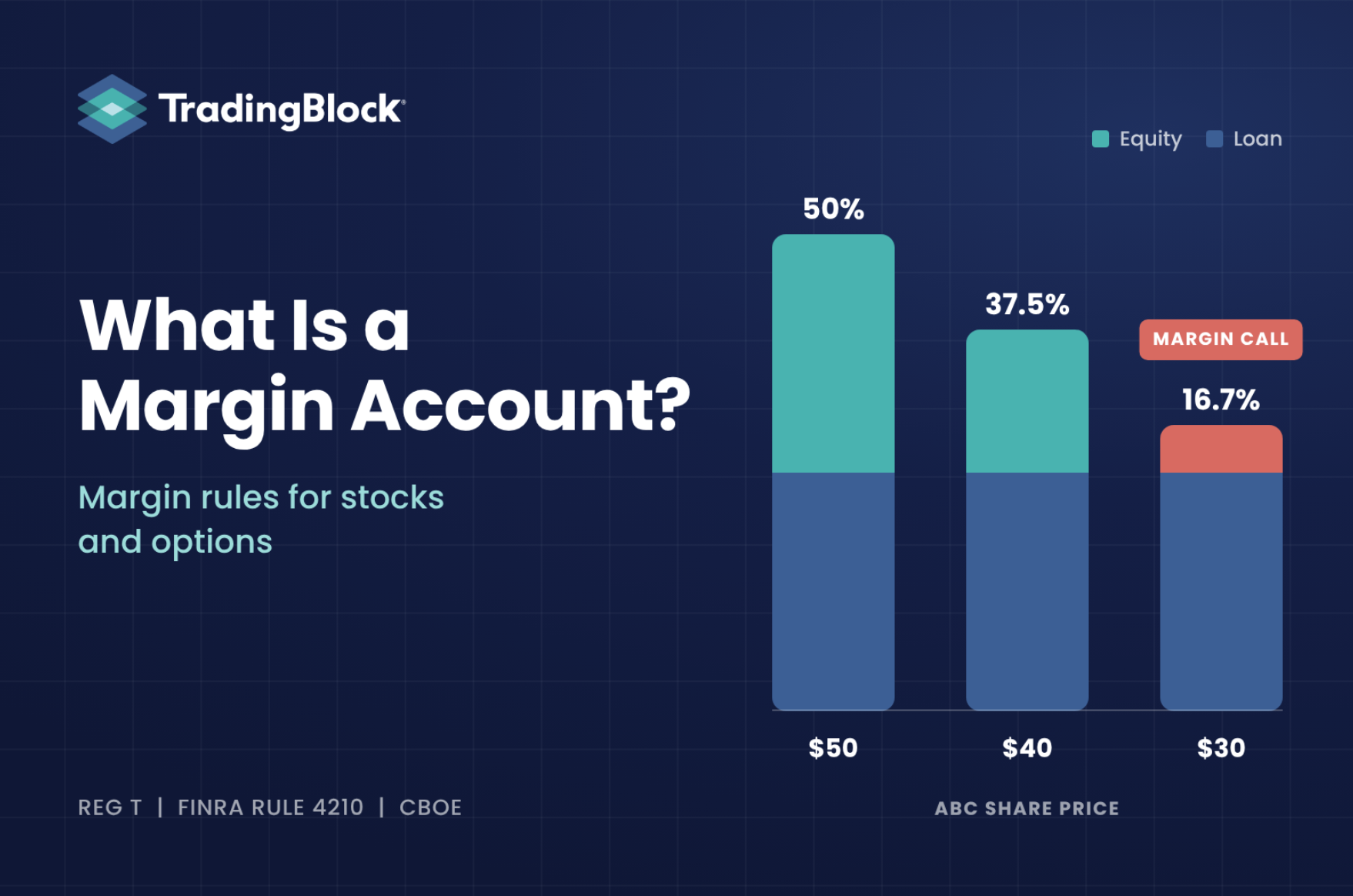
You buy 200 shares of ABC at $50. You pay $5,000 and borrow $5,000. The loan stays fixed, so your equity moves dollar for dollar with ABC.
A 40% drop, from $50 to $30, wipes out 80% of your $5,000. At $30, the 25% minimum requires $1,500 of equity, so the call is for $500. Find your trigger price before you trade:
Margin call price = Loan ÷ (Shares × (1 − Maintenance %))
For ABC at 25%, that is $33.33. At a 30% house requirement, it is $35.71.
How Margin Calls Work
A margin call is a demand to bring your account back up to its requirement.
Under a standard margin agreement, your broker can sell positions without contacting you first. If the sale doesn't cover the debt, you owe the rest.
Margin Interest
You pay interest on what you borrow, usually tied to the Fed Funds rate with lower rates on larger balances. TradingBlock's current tiers are on its Pricing & Policies page. At a hypothetical 9%, the $5,000 ABC loan costs about $450 a year. Cash held as collateral for options is not a loan and accrues no interest.
Margin Rules for Options
Options margin follows FINRA Rule 4210 and the Cboe Margin Manual. The requirement tracks how much a position could lose. Buyers pay in full, sellers post collateral, and defined-risk spreads post their max loss.
You also need options approval, which comes in levels, with uncovered options at the top. New to options? Start with our free options trading course.
Uncovered options use two tests, and the requirement is the greater:
- Test 1: The option's value, plus 20% of the underlying, minus any out-of-the-money amount.
- Test 2: The option's value, plus 10% of the underlying for calls, or 10% of the strike price for puts.
These are regulatory minimums. Brokers can require more, and TradingBlock's options margin policies are on its Pricing & Policies page.
Example: Uncovered Put vs Put Spread
ABC trades at $100. Prices assume 45 days to expiration and 40% implied volatility (the market's estimate of how much ABC could move).
Uncovered put: Sell 1 ABC 90 put @ $1.65, collecting $165.
If ABC drops to $88, the put rises to $5.80 and the requirement climbs to $2,340, double where it started. That is how a short option produces a margin call. Our guide to naked calls and puts goes deeper, and the short put calculator runs your own strikes.
Put spread: Sell the 95 put @ $3.15 and buy the 90 put @ $1.65.
Net credit: $1.50
$150 per spread
The worst case is the $500 strike width. Less the $150 credit, the requirement is $350. That is also the max loss, and it stays fixed however far ABC falls, which is why many traders prefer a bull put spread. Test strikes in the vertical spread calculator.
Day Trading on Margin After the PDT Rule
The Pattern Day Trader rule is gone. FINRA's intraday margin standards replaced it on June 4, 2026 (Regulatory Notice 26-10). The $25,000 minimum and the four-trades-in-five-days count no longer apply. What changed:
- Unlimited day trades if your equity covers them. The $2,000 minimum still applies.
- Intraday requirements match overnight ones, which raises the capital needed for many naked option trades.
- Unmet intraday calls lead to a 90-day closing-only restriction after five business days.
- Expiration counts. A 0DTE position held to expiration is treated as a day trade.
Brokers have until October 20, 2027 to fully phase in the rules, so details vary by firm.
Reg T Margin vs Portfolio Margin
Reg T sets a fixed requirement per position. Portfolio margin stress-tests the whole account and often requires less for hedged positions, which means more leverage. It requires at least $100,000 in equity and separate approval. See Reg T vs Portfolio Margin.
Risks of Trading on Margin
- You can lose more than you deposit. A gap down can push equity below zero.
- Positions can be sold without notice at prices you didn't choose.
- Requirements can rise at any time, often around earnings or in volatile markets.
- Short positions carry open-ended risk, and an early exercise and assignment can leave you holding stock the account can't support.
Short Sale Requirements
Shorting stock means selling shares you borrowed, so the borrow comes with its own rules.
- Locate: Before a short sale, your broker must have reasonable grounds to believe the shares can be borrowed and delivered by settlement. This is SEC Regulation SHO. Selling short without a locate, known as naked short selling, is prohibited and can lead to forced buy-ins.
- Borrow fees and recalls: Hard-to-borrow stocks can carry daily borrow fees. A lender can also recall the shares, and your broker may have to buy back your position.
- Short sale price test: If a stock falls 10% or more from the prior day’s close, SEC Rule 201 restricts short sales to prices above the national best bid for the rest of that day and the next.
- Threshold securities: Stocks with large, persistent delivery failures go on a threshold list, which triggers mandatory close-outs and can restrict new short sales.
- Trading halts: Market-wide circuit breakers and single-stock halts pause trading. You may not be able to close a short until trading resumes.
FAQ
A margin call occurs when a broker demands more funds to meet minimum margin requirements. If not met, liquidation may occur.
Portfolio margin looks at the entire portfolio to determine margin levels, while regular margin (Reg T) looks at individual positions. Portfolio margin generally offers lower margin requirements.
The leverage you get with portfolio margins depends on your broker and the positions you are holding. However, PM can go as high as 6:1, but this is not universal.

.png)


.png)
.png)